Advancements in Particle Identification with Neural Networks: Enhancing Muon and Positron Separation
This update presents developments in using Neural Networks (NN) for separating muons from positrons in the MICE experiment at Université de Genève. Key improvements include optimized input variables and the implementation of ADC_left/ADC_right per layer instead of redundant ADC counts. The study resulted in an input purity of 99.542% and retention of significant signal events with reduced background contamination. Future plans involve integrating a semi-independent NN code into G4MICE for enhanced particle identification and analysis, paving the way for a more efficient data reconstruction process.

Advancements in Particle Identification with Neural Networks: Enhancing Muon and Positron Separation
E N D
Presentation Transcript
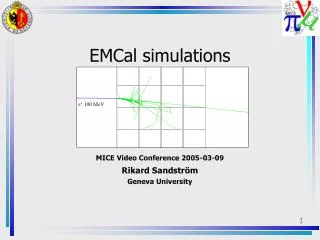
EMCal update Rikard Sandström Universite de Geneve MICE PID 15/6-05
Outline • Introduction • Setup • Input variables • Output • PID – efficiency vs purity • Future plans
Introduction • Using Neural Networks to separate muons from positrons. • See PID phone conference May 25 for details. • Removed the redundant sum of ADC count per layer, exchanged with ADC_left/ADC_right per layer instead. • The sample: • Muons same as before. • Improved description of e+ background.
Beam & detector geometry • As before: • Calorimeter: KLOE-light geometry was used. • The muons were created in TURTLE, interfaced into G4MICE upstream of first tracker. • Full cooling channel and all downstream detectors are in. • New: • Electrons from real decay of muon beam. • Open the gate at 40 ns, after muons hit upstream track ref plane. • Gate open 100 ns. • Added 17 cm/ns delay due to light speed in fibers.
The positron sample • No longer monochrome. • Generated by decaying “real beam”. • Look at first calorimeter hit. • If Truth = muon, tag as signal. • If not, tag as background. • A muon decaying inside EMCal counts as signal. • The 100 ns gate rejects most muon decay at rest. • Result: 124202 signal events, 571 bg events • Input purity = 99.542%.
Comments • Contamination less than half of the 1% expected. • Relative results as good as before (after changing variables). • Heterogeneity of positrons from decay. • Before: P&E > 99.9%, now: P&E = 99.911% simultaneously (at cut = 0.65). • Still did not use • TOF • Momentum measurements • Transversal size • TDC (if any) • Low statistics! • BG efficiency could be better with more data. • Memory leak prevents me from getting larger sample… • Hacked lifetime, but ambiguities arise.
Future plans • Code to build and train NN can be semi-independent part of G4MICE. • The NN is generic, can reject all sort of background it is trained on. • The trained NN is saved to file, so we can use it in G4MICE for reconstruction & analysis. • A future trigger should open the gate. • Now manually set in global time. -> Beam dependent!