Spelling changes in the preterite
100 likes | 228 Vues
In Spanish, certain verbs exhibit spelling changes in the preterite tense, particularly for -car, -gar, and -zar verbs. This guide focuses on how the vowel 'i' changes to 'y' in the formation of the preterite, impacting verbs like "leer" (leí, leíste, leyó) and "construir" (construí, construiste, construyó). Additionally, it highlights specific changes in the yo form of other verbs, such as "buscar" (busqué), "pagar" (pagué), and "empezar" (empecé), which follow unique pronunciation rules. Explore how these spelling transitions enhance your understanding of past tense in Spanish.


Spelling changes in the preterite
E N D
Presentation Transcript
Spelling changes in the preterite i → y -car, -gar, -zar verbs
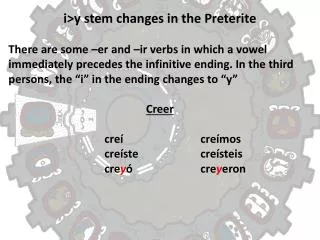
i → y • Verbs that have a vowel at the end of the stem have a spelling change in the preterite • Leer: leí, leíste, leyó (not leió), leímos, leísteis, leyeron (not leieron) • Construir: construí, construiste, construyó (not construió), construimos, construisteis, construyeron (not construieron) • Why?! --- i is a weak vowel and when it is next to an e, a, or u it blends in and sounds more like a y
Act. 4, p. 226 Escribir con compañero
¿Cómo se dice…? …the él/ella form of “buscar” in the preterite? …the yo form of “buscar” in the preterite? How do you pronounce this word? buscé It’s a “soft” c. To make a “hard” c you must add qu. busqué
¿Cómo se dice…? …the él/ella form of “pagar” in the preterite? …the yo form of “pagar” in the preterite? How do you pronounce this word? pagé It’s a “soft” g. To make a “hard” g you must add a u. pagué
¿Cómo se dice…? …the él/ella form of “empezar” in the preterite? …the yo form of “empezar” in the preterite? How do you pronounce this word? empezé “ze” is not allowed in Spanish**, so it changes to… empecé **It has to do with the development from Latin; “z” is borrowed from Greek.
This change happens only in the yo form. -car → -qué -gar → -gué -zar → -cé
Think about English • Some words change spelling when in the past tense • You panic. (present) • You panicked. (past) • I commit. • I committed. • Look at page 227 for more information
¡A trabajar! Página 228, actividad 5