Investigating the Overcooling Problem and Hot Gas Dynamics in Galaxy Evolution
This research explores the "overcooling" problem in galaxy evolution, highlighting the discrepancies between expected and observed galaxy masses due to excessive condensation. By examining hot gaseous halos around the Milky Way and other galaxies, we analyze X-ray emissions, absorption sight lines, and the contribution of hot gas to the overall galactic environment. Utilizing data from ROSAT and Chandra observations, we assess properties of diffuse X-ray-emitting gas, its concentration in galactic disks, and the influence of stellar feedback on preventing cooling flows.

Investigating the Overcooling Problem and Hot Gas Dynamics in Galaxy Evolution
E N D
Presentation Transcript
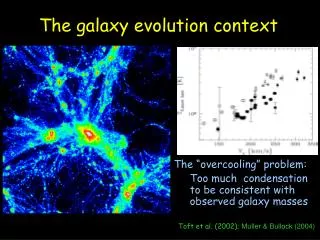
The galaxy evolution context • The “overcooling” problem: • Too much condensation to be consistent with observed galaxy masses Toft et al. (2002); Muller & Bullock (2004)
Hot Gaseous Halos aroundthe Milky Way and Nearby Disk Galaxies Q. Daniel Wang University of Massachusetts In collaboration with Y.-Y. Yao (MIT), Z.-Y. Li, S.-K. Tang (Umass), etc.
ROSAT ¾-keV Diffuse Background Map X-ray binary ~50% of the background is thermal and local (z < 0.01) The rest is mostly from faint AGNs (McCammon et al. 2002)
Absorption Sight Lines X-ray binary AGN ROSAT all-sky survey in the ¾-keV band X-ray binary
Fe XVII K LMXB X1820-303 • In GC NGC 6624 • l, b = 2o.8, -8o • Distance = 7.6kpc tracing the global ISM • 1 kpc away from the Galactic plane NHI • Two radio pulsars in the GC: DM Ne • Chandra observations: • 15 ks LETG (Futamoto et al. 2004) • 21 ks HETG LETG+HETG spectrum Yao & Wang 2006, Yao et al. 2006
X1820-303: Results • Hot gas accounts for ~ 6% of the total O column density • Mean temperature T = 106.34 K • O abundance: • 0.3 (0.2-0.6) solar in neutral atomic gas • 2.0 (0.8-3.6) solar in ionized gas • Hot Ne/O =1.4(0.9-2.1) solar (90% confidence) • Hot Fe/Ne = 0.9(0.4-2.0) solar • Velocity dispersion 255 (165–369) km/s
Mrk 421 (Yao & Wang 2006) • Joint-fit with the absorption lines with the OVII and OVIII line emission (McCammon et al. 2002) • Model: n=n0e-z/hn; T=T0e-z/hT • n=n0(T/T0), =hT/hn, L=hn/sin b OVI 1032 A
Global hot gas properties • Non-isothermal: • mean T ~ 106.3 K toward the inner region • ~ 106.1 K at solar neighborhood • Velocity dispersion from ~200 km/s to 80 km/s • Consistent with solar abundance ratios • A thick Galactic disk with a scale height 1-2 kpc, ~ the values of OVI absorbers and free electrons • No evidence for a large-scale (r ~ 102 kpc) X-ray-emitting/absorbing halo with an upper limit of NH~1 x1019 cm-2
IRAC 8 micro K-band 0.5-2 keV M31 Li & Wang 2007 0.5-1 keV 1-2 keV 2-8 keV Lx~2x1038 erg/s Zh=0.6 kpc, but with flat tails at large z
NW SE NGC 2841 (Sb) • D=15 Mpc • Vc = 317 km/s • Lx ~ 7 x 1039 ergs/s Red: optical Blue: 0.3-1.5 keV diffuse emission Wang et al 2007
NGC 5746 • D=29.5 Mpc • Vc = 307 km/s • Claimed to have a diffuse X-ray halo with r ~ 20 kpc and Lx ~ 4 x 1039 ergs/s (Pederson et al. 2006) • But, …
Extraplanar hot gas seen in nearby galaxies • At least two components of diffuse hot gas: • Disk – driven by massive star formation • Bulge – heated primarily by Type-Ia SNe • Characteristic extent and temperature similar to the Galactic values • No evidence for large-scale X-ray-emitting galactic halos
Observations vs. simulations • Little evidence for X-ray emission or absorption from IGM accretion. No “overcooling” problem? • Missing stellar energy feedback, at least in early-type spirals. Where does the energy go? Galaxy Vc NGC 4565 250 NGC 2613 304 NGC 5746 307 NGC 2841 317 NGC 4594 370 Simulations by Toft et al. (2003)
z=1.2 z=1.2 z=1.2 1-D galaxy formation model • Accretion of both dark and baryon matters • Initial bulge formation (5x10¹⁰ Msun) as a starburst shock-heating and expanding of gas • Continuous Type Ia SNe bulge wind Tang & Wang 2007
Total baryon before the SB Cosmological baryon fraction Total baryon at present Hot gas Evolution of Baryons around galaxies • Galaxies such as the MW evolves in a hot bubble with a deficit of baryon matter • This bubble explains the lack of large-scale X-ray halos. • Bulge wind removes the present stellar feedback. • Results are sensitive to the initial burst and to the bulge/halo mass ratio
Galactic bulge simulation • Energy not dissipated locally • Most of the energy is in the bulk motion and in waves • Parallel, adaptive mesh refinement FLASH code • Finest refinement in one octant down to 6 pc • Stellar mass injection and SNe, following stellar light • SN rate ~ 4x10⁻⁴ /yr • Mass injection rate ~0.1 Msun/yr) 10x10x10 kpc3 box density distribution
The fate of the energy • Maybe eventually damped by cooling gas in the galactic hot halo. • Galactic wind not necessary, depending the galaxy mass and IGM environment. • Interaction with the infalling IGM a solution to the over-cooling problem. kpc
Conclusions • Diffuse X-ray-emitting gas is strongly concentrated toward galactic disks and bulges. No X-ray evidence for large-scale halos on scales > ~ 20 kpc. • Heating is mostly due to SNe. But the bulk of their energy is not detected and is probably propagated into the halo. • Feedback from a galactic bulge likely plays a key role in galaxy evolution: • Initial burst heating and expansion of gas beyond the virial radius • Ongoing Type Ia SNe keeping the gas from forming a cooling flow
NGC 5775 Diffuse X-ray emission compared with HST/ACS images Red – H Green – Optical R-band Blue – 0.3-1.5 keV