Building Foundations for EarthCube: Advancing Holistic Geosciences Understanding
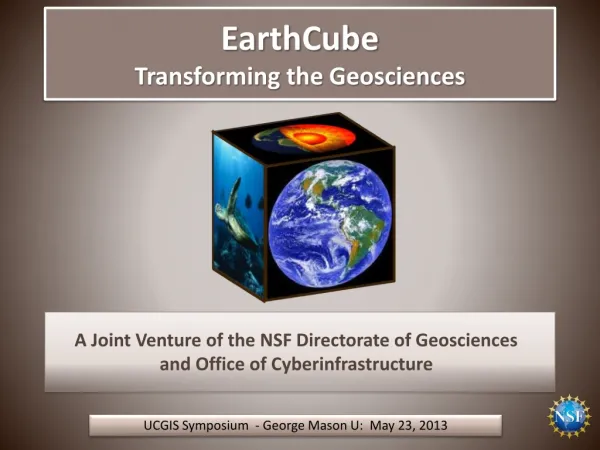
EarthCube aims to deepen our understanding of the Earth and its interactions through an interdisciplinary approach, integrating knowledge from various scientific and engineering disciplines. The geosciences community will develop a framework to understand and predict Earth’s system responses, encompassing everything from the space-atmosphere boundary to the Earth’s core and human influences. With a focus on addressing challenges in data sharing and resource distribution, EarthCube encourages collaboration amongst geoscientists, computer scientists, and stakeholders to create a cohesive, community-driven platform over the next decade.

Building Foundations for EarthCube: Advancing Holistic Geosciences Understanding
E N D
Presentation Transcript
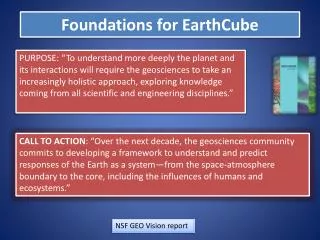
Foundations for EarthCube PURPOSE: “To understand more deeply the planet and its interactions will require the geosciences to take an increasingly holistic approach, exploring knowledge coming from all scientific and engineering disciplines.” CALL TO ACTION: “Over the next decade, the geosciences community commits to developing a framework to understand and predict responses of the Earth as a system—from the space-atmosphere boundary to the core, including the influences of humans and ecosystems.” NSF GEO Vision report
Motivations • Interdisciplinary Science Questions • Big, Heterogeneous Data issues • Communities that are poorly served/have no community resources • ~$100M on CI in GEO alone http://www.whitehouse.gov/administration/ eop/ostp/library/publicaccesspolicy Federal Science Agencies Geoscientist
Frontiers in Earth Systems Dynamics Data + Teams + Models
EarthCube Supports the Geosciences ANT Glaciology NCAR Paleo-Climate Petrology Geochemistry Solar Terrestial ANT Astro & Geospace Tectonics EAR Ed. Atm. Chemistry Aeronomy EarthScope ANT Earth Sciences Phy. & Dyn Met. Geophysics Clm & Large Scale Dyn IES Magneto-spheric Phys. ARC Natural Sciences Hydrology ARC Sys Science (ARCSS) Geobio & Low Temp Geochem Sediment Geology and Paleobio ARC Obs. Network (AON) EarthCube CI Geomomorphology & land use dyn ARC Social Sciences PhysOcean Biological Infrastructure ANT Ocean & Atm. Sci. Envir. Biology GeoPRISM OOI Software Emerging Frontiers (BIO) High Perf Computing OceanDrilling Biological Ocean Marine Geology & Geo-phys Networks OCE ED ANT Organisms & Ecosys. Chem Ocean Data
Community Motivations State of the Geosciences: • Getting Science done now and in the future--Science drivers and aspirations • Similar barriers and challenges across communities • There are many similar activities/solutions to barriers without much cross-communication • Assessing distribution of resources (data and CI) and access to them Top Six Barriers to Sharing Data (survey): • No time/Not enough time for QA/QC • No repository or known repository • Inadequate standards, standardized formats, etc. • Want to publish first/not be scooped • File size too large/server size too small • No credit/incentive for sharing
EarthScope Workshop Ensemble Assimilation Workshop • Considerable difficulty accessing data--heterogeneity; standards and formats • Legacy Data • Data Integration • Errors, uncertainty, reproducibility • Scaling algorithms; moving big data • Too much overhead to integrate data • No easy to use standards and frameworks • Significant time required to prepare, process data, esp students • barriers to collaboration between geoscientists and CS, Math, Statistics
The EarthCube Strategy DataOne CUASHI Unidata • The process must • Engage all stakeholders: Geosciences end-users • Geosciences and CI facilities • CI and Computer Science specialists • Build upon existing resources, understanding that different geosciences communities are not uniformly served • Build EarthCube iteratively, with community input and assessment in yearly intervals NCAR IEDA IRIS OOI
Timeline Roadmaps/ Frameworks • EAGER & Wkshop Phase Strategic Portfolio of Activities First DCL Aug-Sep 2012 Dec 2011-June 2012 Dec 2012 June2012 June 2011 Nov 2011 • JuneCharrette Solicitation • FirstCharrette FY 2013-FY 2015
FY13 Themes: Engage Stakeholders Geoscientists Academic Researchers Geosciences Facilities Students Industry • Governance • Community • Engagement Geo-ed Computer Scientists • Architecture • Resource • Leveraging Geosciences Cyberinfrastructure CI Experts Builders CI Resources Data Providers
How Will It All Fit Together:Phased Approach NSF Review Community- Run Status Assessment
Questions and Comments? earthcube@nsf.gov
Governance Test Enterprise Governance • Two stage process • Facilitate the creation of a terms of reference engaging the appropriate organizations and people • Demonstrate the terms of reference • Coordinate, organize and set priorities for a complex set of activities that will change over time
Community • Engagement Research Coordination Networks RCN • Geoscientists • RCN Output Steering Committee; Coordination Activities; Collaborations • Planning activity for geosciences communities • Shared resources • Representative plans for needed CI • Data/CI standards • Multi-disciplinary is preferred • Communication and Participation Required
EarthCube Amendment II • Resource • Leveraging • Architecture • May 22 deadline • Building Blocks • 4-6 awards; 2yrs; up to$2m • Conceptual Designs • 3-5 awards; 2yrs; $300k
Resource • Leveraging Building Blocks Input from EC, end-users, architecture Initial integration of current resources Next Building Blocks Stage 2 Outcomes • Demo utility to geosciences communities within 24 months • How does the approach extend and fit into “ecosystem” Proposals must • Have credible links to end-users geosciences communities—not just a subset • Motivate how the solution might be broadly applied across ALL geosciences community
Architecture Conceptual Designs Software Stogare Communities Networks Compute, Initial planning for Enterprise Architecture • CI Architecture Teams • Understand the landscape of existing resources • Consider innovative designs for an evolving system • Output Conceptual Design Reports • Engage end users • Presented to other EarthCubers • Discussion about different approaches • Phased Approach