Download
1 / 14
140 likes | 256 Vues
Discover the essential role of prairies in maintaining biodiversity and soil health. Learn about their unique ecosystems, which feature over 30 grass species and 250 flowering plants, supported by rich soils containing up to 120 tons of organic matter per acre. Understand the impact of human activities, including agriculture, which has led to critical habitat loss, especially east of the Missouri River. Explore the benefits of prairie restoration, such as attracting wildlife, improving air and water quality, and enhancing aesthetics, while following best practices for planting native species and managing weeds.

E N D
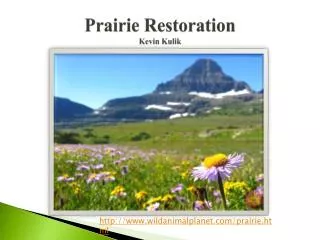
Prairie RestorationKevin Kulik http://www.wildanimalplanet.com/prairie.html
What is a Prairie? • French explorers first came across what they called “Prairies” which was their word for meadows. • One of the earliest formal definitions of a Prairie was by John T. Curtis, an ecologist at The University of Wisconsin. • -An open community dominated by grasses, and having less than one tree per acre.
Plants of the Prairie • Over 30 grass species • Extensive roots • Decay in Place • Over 250 forb species • Sunflower • Milkweed • Less extensive roots
Animals of the Prairie • Bison • Prairie Dog • Badger • Grasshopper • Butterfly • Ant
Soil • Contain 120 tons of organic matter per acre • Forests in comparison contain 70tons/acre • Grass roots extend 5 to 7 feet down • Enrich the soil with nutrients as they decay • Ants build mounds and as they do so mix and aerate the soil. • Bring up nutrients and clay particles from subsoil. • Abandon mounds continuously and build new ones.
Along comes Agriculture • Prairies exploited because of their rich soil. • East of the Missouri • Critically Endangered • 99% of Prairies lost • West of the Missouri • Endangered • 85% of Prairies lost http://projectgroupb.wordpress.com/the-amish-culture/ “The tossing, blooming, perfumed grass is swept away by wheat” -Vachel Lindsay
More Human Impact… • Most Bison have been eliminated • Added certain livestock • Cows, Pigs, etc. • Altered Water Tables • Suppressed Natural Fires http://www.amazon.com/Settlers-Plains-Fighting-Prairie-Giclee/dp/B0033F5E50
Benefits of Restoration • Attract Wildlife • Songbirds, Butterflies, Bison • Environmental Benefits • Deep root system helps improve water quality • Improves air quality • Improved Aesthetics • More diversity and more appealing than farm land • Education • Provide a place where people can take their kids and teach them about nature
Starting Off • Collect seeds • Buy from supplier • Collect by hand if from rare plants • When Collecting • Take no more than 50% of seed pop from perennials • Take no more than 10% of annual plants http://www.fs.fed.us/wildflowers/rareplants/conservation/success/frozen_garden.shtml
Planting and Dealing with Weeds • The amount of weed seed present in the planting site is one of the most unpredictable factors in prairie restoration. • This can be counteracted by Planting in the middle of the growing season • Allows weeds to grow and be eradicated before Prairie plants are planted. • Planting and then mowing taller weeds and leaving smaller Prairie plants unharmed Is also effective
Fire in the Restoration • Fire can be used to reduce weeds. • This effectively provides more nourishment for native prairie plants • In the later stages of restoration fire helps keep out woody species. • Burning should be done in Spring • This provides cover for wildlife in the colder winter months. http://blog.travelks.com/prairie-fire-festival-honors-dramatic-flint-hills-tradition/
Adding Bison • If site is large enough Bison can be added • To sustain bison • 1,000 acres supports around 90 bison units • 1 bison unit = 1 1,000 pound bison • Bison grow annually by 80-90% based on mature females • Remove oldest and youngest once ideal pop has been reached • Sell for profit http://buffalo-meat.info/buffalo-meat-facts/
Benefits of Bison • Forage Selectively on Grasses • Increase other plants abundance • Wallow • Create great habitats for weeds • Once burned these weeds give way to Prairie Pioneers http://www.npcn.net/index.php/pages/pages_template/documents/bittercreek_sum.PDF/P10/
Resources • "Benefits of Prairies." HCUCA. Hamilton County Urban Conservation Association, Inc. Web. 21 Apr. 2011. <http://www.hamiltoncountyuca.org/prairiebenefits.html> • Howe H. F., 1994. Managing Species diversity in Tallgrass Prairie: Assumptions and Implications. Conservation Biology *: 691-704 • Karnowski, Steve. "Bison Market Expanding Fast | The Journal Gazette | Fort Wayne, IN."JournalGazette.net - Home Page | The Journal Gazette | Fort Wayne, IN. Associated Press, 10 Jan. 2011. Web. 21 Apr. 2011. • Noss, R. F., E. T. LaRoe III, and J. M. Scott. 1995. Endangered Ecosystems of the United States: a Preliminary assessment of Loss and Degradation. Biological Report 28. National Biological Service, Washington, D. C., USA. • Packard, Stephen, and Cornelia Fleischer. Mutel. The Tallgrass Restoration Handbook: for Prairies, Savannas, and Woodlands. Washington, D.C.: Island, 1997. Print. • Schramm, P. 1978. The ‘‘do’s’’ and ‘‘don’ts’’ of prairie restoration. Pages 139–150 in D. C. Glenn-Lewin and R. C. Landers, editors. Proceedings of the Fifth Midwest Prairie Conference, Iowa State University, Ames, Iowa, US • Shirley, Shirley. Restoring the Tallgrass Prairie: an Illustrated Manual for Iowa and the Upper Midwest. Iowa City: University of Iowa, 1994. Print.