Download
1 / 14
150 likes | 279 Vues
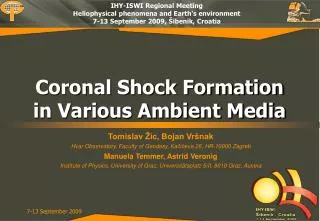
This study investigates the initiation and evolution of coronal shock waves, supported by the Croatian Scientific Foundation under project 6212: "Solar and Stellar Variability". Key observational signatures such as Type II radio bursts and Moreton waves are explored. The work delves into the mechanisms behind shock formation, emphasizing the role of impulsive plasma motion and the nonlinear evolution of perturbations. Using simulations, we analyze the growth, steepening, and dynamics of these shock waves, revealing their implications for understanding solar dynamics.

E N D
INITIATIONAND EVOLUTIONOFCORONAL SHOCK WAVES B. Vršnak, T. Žic, S. Lulić (Hvar Obs.) N. Muhr, A. Veronig, M. Temmer, I. Kienreich (Uni.-Graz) This work hasbeensupportedinpartbyCroatianScientificFoundation underthe project 6212 „SolarandStellarVariability“ (SOLSTEL).
Observational signatures • Type II radio bursts (Wild & McCready 1950, Aust.J.Phys. 3, 387) • Moreton waves (Moreton & Ramsey 1960, PASP 72, 357) KSO
NRH EUV, SXR, HeI, coronograph, radio,... Yohkoh EIT/SoHO MLSO
Domain / Signature in situ IP (radio, WL) Low Corona (EUV) Corona - radio type II - WL fronts, streamers Upper Chromosphere & TR (Ha, HeI, …) Moreton, disturbed filaments, … timing, kinematics, intensity,spectral, morphology, …
Terminology piston shock bow shock
w w u u vA0 xf x Large-amplitude wave (shock) • impulsive plasma motion perpendicular to the magnetic field ("strong" acceleration) • large amplitude wavefront is created • shock forms after certain time/distance due to the nonlinear evolution of the perturbation (signal velocity depends on the amplitude!) w(t) = w0 + k u(t) k=4/3, w0=cs0 at b >> 1 k=3/2, w0=vA0 at b << 1
PistonMechanism (simulations) 1D - planar wave piston • - amplitude growth + steepening shockformation • after t~0.15 ~const. amplitude/velocity 2D - cylindrical dip • amplitude growth + steepening shock formation • - lower amplitude, formation of rarefaction region • after t~0.08 decreasing amplitude/velocity
2.5-D MHD simulation + By Bz Bf b = 0
MHD simulation: Corona (horizonatal) wave 0.2 0.1 0.08 piston • steepening + ampl. increaseshock • - deceleration; ampl. decrease • corona/Moretonoffset • corona/Moretondelay 0.2 0.1 0.08 piston
MHD simulation: Corona (above) contact surface “standing” shock streamer (currentsheet) (reconnectionoutflowjet) fast-mode standingshock
comparisonwithanalytical: • v2w = const.; • cs = 10 km/s = const. MHD simulation: Moretonwave
Conclusion • upward (type II burst) = driven bow/piston shock • lateral (EUV, HeI, Ha) = temporary piston (“CME overexpansion”) • the time/distance of the shock formation and its amplitude/speed depend strongly on the impulsiveness of the piston • Moreton wave appears only if shock is sufficiently strong (fast); only the upper chromosphere is affected • downward propagating chromospheric disturbance is quasi-longitudinal fast-mode shock that can be well approximated by a sound shock • Moreton wave lags behind the coronal wave due to chromospheric inertia