Download
1 / 44
440 likes | 574 Vues
This presentation provides an overview of fundamental statistical concepts, focusing on distributions, particularly the normal distribution, and the least-squares method. It discusses the significance of histograms, probability density functions, correlation, and covariance in analyzing data. The presentation also explores linearizing techniques for overdetermined and underdetermined problems, specifically in the context of physical geodesy and gravity modeling. Key statistical principles are illustrated using real-world examples and numerical data, emphasizing the application of least-squares estimation methods.

E N D
Basic statistical concepts and least-squares. Sat05_61.ppt, 2005-11-28. • Statistical concepts • Distributions • Normal-distribution 2. Linearizing 3. Least-squares • The overdetermined problem • The underdetermined problem
Histogram. Describes distribution of repeated observations At different times or places ! Distribution of global 10 mean gravity anomalies
Statistic: Distributions describes not only random events ! We use statistiscal description for ”deterministic” quantities as well as on random quantities. Deterministic quantities may look as if they have a normal distribution !
”Event” Basic concept: Measured distance, temperature, gravity, … Mapping: Stocastisc variabel . In mathematics: functional, H – function-space – maybe Hilbertspace. Gravity acceleration in point P: mapping of the space of all possible gravity-potentials to the real axis.
Probability-density , f(x): What is the probability P that the value is in a specific interval:
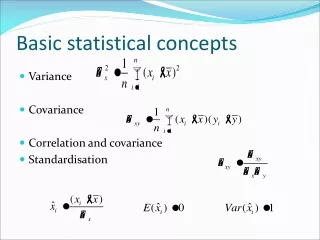
Variance-covariance in space of several dimensions: Mean value and variances:
Correlation and covariance-propagation: Correlation between two quantities: = 0: independent. Due to linearity
Mean-value and variance of vector If X and A0 are vectors of dimension n and A is an n x m matrix, then The inverse P = generally denoted the weight-matrix
Distribution of the sum of 2 numbers: • Exampel Here n = 2 and m = 1. We regard the sum of 2 observations: • What is the variance, if we regard the difference between two observations ?
Normal-distribution 1-dimensional quantity has a normal distribution if • Vektor of simultaneously normal-distributed quantities if • n-dimensional normal distribution.
Covarians-propagation in several dimensions: X: n-dimensional, normally distributed, D nxm matrix , then Z=DZ also normal distributed, E(Z)=D E(X)
Covarians function If the covariance COV(x,y) is a function of x,y then we have a Covarians-function May be a function of • Time-difference (stationary) • Spherical Distance, ψ on the unit-sphere (isotrope)
Normally distributed data and resultat. If data are normaly dsitributed, then the resultats are also normaly distributed If they are linearily related ! We must linearize – TAYLOR-Development with only 0 and 1. order terms. Advantage: we may interprete error-distributions.
Distributions in infinite-dimensional spaces V( P) element in separable Hilbert-space: Normal distributed with sum of variances finite !
Stochastic process. What is the probability P for the event is located in a specific interval Exampel: What is the probability that gravity in Buddinge lies in between -20 and 20 mgal and that gravity in Rockefeller lies in the same interval
Stokastisc process in Hilbertspace What is the mean value and variance of ”the Evaluation-functional”,
Covariance function of stationary time-series. Covariance-function depends only on |x-y| Variances called ”Power-spectrum”.
Covariance function – gravity-potential. • Suppose Xij normal-distributed with the same variance for constant ”i”.
Linearizering: why ? We want to find best estimate (X) for m quantities from n observations (L). Data normal-distributed, implies result normaly distributed, if there is a linear relationship. If m > n there exist an optimal metode for estimating X: Metode of Least-Squares
Linearizing – Taylor-development. If non-linear: Start-værdi (skøn) for X kaldes X1 Taylor-development with 0 og 1. order terms after changing the order
Covariance-matrix for linearizered quantities If measurements independently normal distributed with varians-covariance Then the resultatet y normal-dsitributed with variance-covarians:
Linearizing the distance-equation. Linearized based on coordinates
On Matrix form: If 3 equations with 3 un-knowns !
Numerical-example If (X11, X12,X13) = ( 3496719 m, 743242 m, 5264456 m). Satellite: (19882818.3, -4007732.6 , 17137390.1) Computed distance: 20785633.8 m Measured distance: 20785631.1 m ((3496719.0-19882818.3)dX1 + (743242.0-4007732.6) dX2+(5264456 .0-17137390.1) dX3)/20785633.8 = ( 20785631.1 - 20785633.8) or: -0.7883 dX1 -0.1571 dX2 + 1.7083 dX3 = -2.7
Linearizing in Physical Geodesy based on T=W-U In function-spaces the Normal-potential may be regarded as a 0-order term in a Taylor-development.We may differentiate in Metric space (Frechet-derivative).
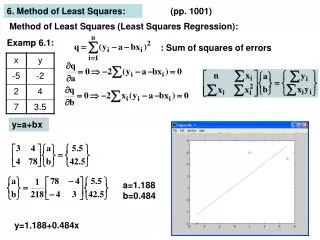
Method of Least-Square. Over-determined problem. More observations than parameters or quantities which must be estimated: Examples: GPS-observations, where we stay at the same place (static) We want coordinates of one or more points. Now we suppose that the unknowns are m linearily independent quantities !
Least-squares = Adjustment. • Observation-equations: • We want a solution so that Differentiation:
Metod of Least-Squares. Linear problem. Gravity observations: H, g=981600.15 +/-0.02 mgal 12.11+/-0.03 -22.7+/-0.03 G 10.52+/-0.03 I
Method of Least-Squares. Over-determined problem. Compute the varianc-covariance-matrix
Method of Least-Squares. Optimal if observations are normaly distributed + Linear relationship ! Works anyway if they are not normally distributed ! And the linear relationship may be improved using iteration. Last resultat used as a new Taylor-point. Exampel: A GPS receiver at start.
Metode of Least-Squares. Under-determined problem. We have fewer observations than parameters: gravity-field, magnetic field, global temperature or pressure distribution. We chose a finite dimensional sub-space, dimension equal to or smaller than number of observations. Two possibilities (may be combined): • We want ”smoothest solution” = minimum norm • We want solution, which agree as best as possible with data, considering the noise in the data
Method of Least-Squares. Under-determined problem. Initially we look for finite-dimensional space so the solution in a variable point Pi becomes a linear-combination of the observations yj: If stocastisk process, we want the ”interpolation-error” minimalized
Method of Least-Squares. Under-determined problem. Covariances: Using differentiation: Error-variance:
Method of Least-Squares. Gravity-prediction. R 4 km 8 km Example: Covarianses: COV(0 km)= 100 mgal2 COV(10 km)= 60 mgal2 COV(8 km)= 80 mgal2 COV(4 km)= 90 mgal2 Q 10 mgal P 6 mgal 10 km
Method of Least-Squares. Gravity prediction. Continued: Compute the error-estimate for the anomaly in R.
Least-Squares Collocation. Also called: optimal linear estimation For gravity field: name has origin from solution of differential-equations, where initial values are maintained. Functional-analytic version by Krarup (1969) Kriging, where variogram is used closely connected to collocation.
Least-Squares collocation. We need covariances – but we only have one Earth. Rotate Earth around gravity centre and we get (conceptually) a new Earth. Covariance-function supposed only to be dependent on spherical distance and distance from centre. For each distance-interval one finds pair of points, of which the product of the associated observations is formed and accumulated. The covariance is the mean value of the product-sum.
Covarians function for gravity-anomalies: Different models for degree-variances (Power-spectrum): Kaula, 1959, (but gravity get infinite variance) Tscherning & Rapp, 1974 (variance finite).