Elementary Crystallography
Crystallography is the scientific study of crystals, which are solid materials with constituent atoms, molecules, or ions arranged in an orderly, repeating pattern in three-dimensional space. A unit cell is the smallest portion of a lattice that can be indefinitely repeated to create the entire structure. This guide explores symmetry operations, including translation, rotation, reflection, inversion, and glide translation, with a focus on their applications in two- and three-dimensional lattices. Discover the fundamental principles of crystallography and crystal formation!

Elementary Crystallography
E N D
Presentation Transcript
Elementary Crystallography Or, driving yourself crazy
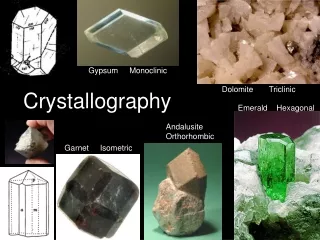
Definition of a Crystal A crystal or crystalline solid is a solid material, whose constituent atoms, molecules, or ions are arranged in an orderly repeating pattern extending in all three spatial dimensions. The scientific study of crystals and crystal formation is crystallography
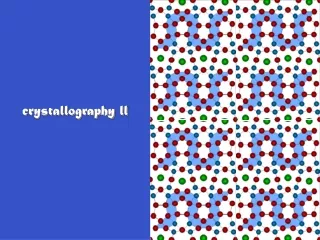
Definition of a Unit Cell For any given lattice, a unit cell can be defined as the smallest portion of the lattice that can be repeated indefinitely to form it. A lattice is defined as a pattern that repeats a motif by repeated translations through an interval t.
Escher 2d lattice Find the unit cell
Symmetry Operations 1. Translation 2. Rotation 3. Reflection 4. Inversion 5. Glide
Rotation Nomenclature A2 2-fold A3 3-fold A4 4-fold A6 6-fold
The previous were examples in 2 dimentions What happens in 3D We will look at a few models
Compound operations 1. screw axis t plus rotation 2. Glide plane t plus reflection 3. Roto-inversion (this is where we have fun)