SlideServe
Menu
Préférences
© SlideServe · v2026

Crystallography

savarese avatar
13 diapositives · 244 Views · Jan 04, 2020

Delve into the intricate world of crystallography and explore the diverse symmetry operations present in crystal structures, from mirror planes to rotoinversion axes. Learn about the different crystal systems and their unique characteristics.
Crystallography - slide 1
01 / 13Crystallography
1 / 17

Télécharger la présentation

Crystallography
Une image / un lien ci-dessous est fourni (tel quel) pour télécharger la présentation

Politique de téléchargement : le contenu du site vous est fourni TEL QUEL pour votre information et votre usage personnel ; il ne peut être vendu, concédé sous licence ni partagé sur d’autres sites sans l’accord de son auteur.Le contenu vous est fourni TEL QUEL, pour votre information et votre usage personnel uniquement. Téléchargez la présentation en cliquant sur ce lien. Lors du téléchargement, si vous ne parvenez pas à télécharger une présentation, l’éditeur a peut-être supprimé le fichier de son serveur.Pendant le téléchargement, si vous ne parvenez pas à obtenir une présentation, le fichier a peut-être été supprimé par l’éditeur.

F I N

Plus de contenu associé

Transcription de la présentation
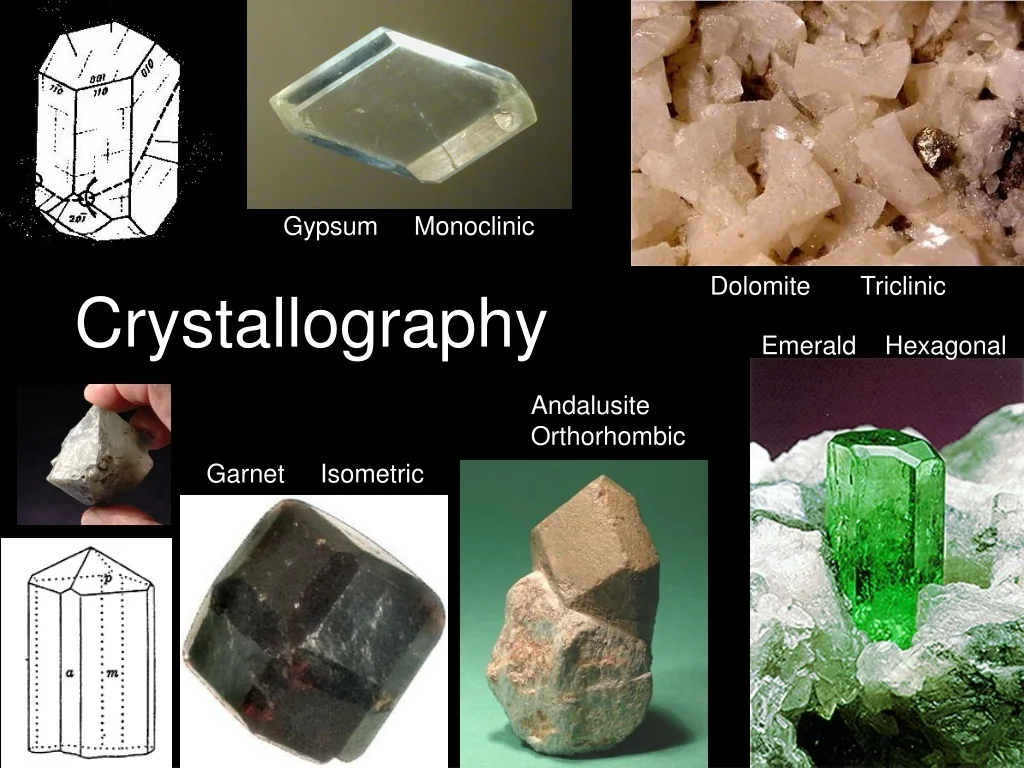
  1. Crystallography Gypsum Monoclinic Dolomite Triclinic Emerald Hexagonal Andalusite Orthorhombic Garnet Isometric

  2. Symmetry Symbols • Reflection (m)- produced by a mirror plane that passes through a crystal structure so the pattern on one side is a mirror image of the pattern on the other. (symmetry over a plane) • How many mirror planes do these crystals have? Both have 3! So notation is 3m

  3. Rotation (A)- rotational symmetry involves repeating a motif by a set of uniform rotations around an axis. (symmetry about an axis) • Repeating the pattern every 120° of rotation means 3-fold symmetry. • Every 60° = 6-fold symmetry • Denoted as #Ax where x=x fold rotational symmetry Orthorhombic- 3 axes of 2-fold symmetry, so notation is 3A2

  4. More rotation examples www.tulane.edu/~sanelson

  5. Inversion (i)- also known as center symmetry. Any line drawn through the origin will find identical features equidistant from the origin on the opposite side. Both of these crystals have center symmetry (i)

  6. Rotoinversion (Āx) - involves a rotation and inversion to repeat a pattern • Denoted as #Āx where x=x fold rotational symmetry • Note Ā1 = i and Ā2 = m i 3Ā3 m

  7. The 32 crystal classes represent the 32 possible combinations of symmetry operations.  • Each crystal class will have crystal faces that uniquely define the symmetry of the class.  • These faces, or groups of faces are called crystal forms.

  8. Note that the 32 crystal classes are divided into 6 crystal systems. • The Triclinic System has only 1-fold or 1-fold rotoinversion axes. • The Monoclinic System has only mirror plane(s) or a single 2-fold axis. • The Orthorhombic System has only two fold axes or a 2-fold axis and 2 mirror planes. • The Tetragonal System has either a single 4-fold or 4-fold rotoinversion axis. • The Hexagonal System has no 4-fold axes, but has at least 1 6-fold or 3-fold axis. • The Isometric System has either 4 3-fold axes or 4 3-fold rotoinversion axes.

  9. Symmetry Operation Symmetry Symbol Hermann-Mauguin Symbol Mirror m m Rotation A1,A2,A3,A4,A6 1,2,3,4,6 Axis Rotoinversion Ā1=i, Ā2,Ā3,Ā4,Ā6 1,2,3,4,6 Axis - - - - -

  10. Miller Indices

  11. Miller Indices

  12. Created by Nicolas Barth2007Geology 114BUniversity of California, Santa BarbaraSome images herein borrowed from websites have not been credited