Understanding the Cloning Process in NiObject and NiAVObject
This documentation provides an in-depth overview of the cloning process within the NiObject and NiAVObject classes. It details the methods responsible for cloning objects, including `Clone()`, `CopyMembers()`, and `CloneProperties()`, as well as how the cloning process is managed through `NiCloningProcess`. The information highlights the importance of sharing properties among multiple NiAVObjects and explains how properties are cloned using shared references to optimize efficiency in 3D rendering applications.

Understanding the Cloning Process in NiObject and NiAVObject
E N D
Presentation Transcript
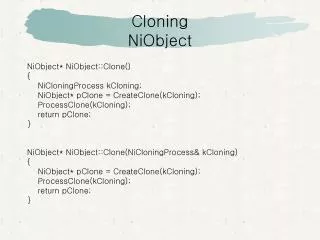
CloningNiObject NiObject* NiObject::Clone() { NiCloningProcess kCloning; NiObject* pClone = CreateClone(kCloning); ProcessClone(kCloning); return pClone; } NiObject* NiObject::Clone(NiCloningProcess& kCloning) { NiObject* pClone = CreateClone(kCloning); ProcessClone(kCloning); return pClone; }
Cloning (cont.)NiObject void NiObject::CopyMembers(NiObject* pDest, NiCloningProcess& kCloning) { kCloning.m_pkCloneMap->SetAt(this, pDest); } NiObject* NiObject::CreateSharedClone(NiCloningProcess& kCloning) { NiObject* pkClone; if (kCloning.m_pkCloneMap->GetAt(this, pkClone)) return pkClone; else return CreateClone(kCloning); }
Cloning (cont.)NiAVObject • NiCloningProcess가 필요한 이유 • Property를 다수의 NiAVObject가 공유할 수 있기 때문 void NiAVObject::CloneProperties(NiAVObject* pkDest, NiPropertyList* pkList, NiCloningProcess& kCloning) { NiTListIterator kPos = pkList->GetTailPos(); while (kPos) { NiProperty* pkProperty = pkList->GetPrev(kPos); pkDest->AttachProperty((NiProperty*)pkProperty->CreateSharedClone( kCloning)); } }
Clone (cont.)NiNode void NiNode::ProcessClone( NiCloningProcess& kCloning) { NiAVObject::ProcessClone(kCloning); NiObject* pkClone; bool bCloned = kCloning.m_pkCloneMap->GetAt(this, pkClone); NiNode* pkNode = (NiNode*) pkClone; const NiDynamicEffectList *pkList = &GetEffectList(); if (!pkList->IsEmpty()) pkNode->CopyEffectListClones(pkList, kCloning); … }