Understanding Pain Perception: Myths and Facts About Pain Signals
Explore the complexities of pain perception in the human body. This guide debunks common myths about how pain is processed, highlighting the roles of myelinated and unmyelinated axons, the sensory receptors present in internal organs, and the emotional aspects influencing our pain experience. Learn about the fascinating phenomena of stabbing and aching pains, phantom limb sensations, and how different medications affect pain relief. Gain insights into the physiology of pain signaling and the importance of the brain's role in both sending and receiving pain information.

Understanding Pain Perception: Myths and Facts About Pain Signals
E N D
Presentation Transcript
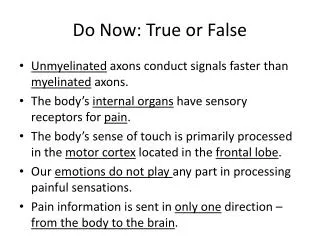
Do Now: True or False • Unmyelinated axons conduct signals faster than myelinated axons. • The body’s internal organs have sensory receptors for pain. • The body’s sense of touch is primarily processed in the motor cortex located in the frontal lobe. • Our emotions do not play any part in processing painful sensations. • Pain information is sent in only one direction – from the body to the brain.
Why do we first feel a stabbing pain, and then later feel an aching pain? First Stabbing Pain Second Aching Pain
Why do people feel pain in their arm when they are having a heart attack?
Why do amputees feel pain in their missing limbs? Phantom Limb Pain Somatosensory Cortex Missing Input Mirror Box Therapy
Why do our emotions play a large role in how we perceive pain?
How do medicines that relieve pain work? Opioids Descending pain pathway Ascending pain pathway Opioids Local anesthetics Local anesthetics Anti-inflammatory drugs Pain Receptors
Wrap Up: True or False • Unmyelinated axons conduct signals faster than myelinated axons. • FALSE • Myelinatedaxons conduct signals faster than unmyelinated axons.
Wrap Up: True or False • The body’s internal organs have sensory receptors for pain. • TRUE
Wrap Up: True or False • The body’s sense of touch is primarily processed in the motor cortex located in the frontal lobe. • FALSE • The body’s sense of touch is primarily processed in the somatosensory cortex located in the parietal lobe.
Wrap Up: True or False • Our emotions do not play any part in processing painful sensations. • FALSE • Our emotions play a large role in processing painful sensations.
Wrap Up: True or False • Pain information is sent in only one direction – from the body to the brain. • FALSE • Pain information is sent in twodirections – from the body to the brain, AND from the brain to the body.