Enhancing Printmaking Skills through Artist Influence and Technique Application
60 likes | 178 Vues
This assessment task focuses on producing a repeat print inspired by the works of renowned artist M.C. Escher. The pupil has selected relevant references and created a visual representation through cut and paste techniques, showcasing observational drawing and written commentary. However, the exploration of materials and printmaking techniques remains limited, hindering the refinement of the final outcome. To achieve Entry 3, the pupil must demonstrate a deeper engagement with printmaking processes, materials, and the ability to adapt their creative ideas effectively.


Enhancing Printmaking Skills through Artist Influence and Technique Application
E N D
Presentation Transcript
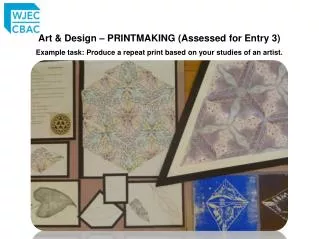
Art & Design – PRINTMAKING (Assessed for Entry 3) Example task: Produce a repeat print based on your studies of an artist.
AC1.1 Select a range of references and resources to support printmaking activities. The pupil has selected appropriate references and resources, however, this area would have benefited from a wider range of initial references. AC1.2 Produce visual and / or tactile records of observations and experiences relating to a task or theme. The pupil has used cut and paste to recreate an Escher repeat pattern. There is also evidence of observational drawing to record experiences as well as written comments.
AC1.3 Identify the influence of artists, craftspersons and / or designers on their own practice. The final design relates clearly to the influence of M. C. Escher's repeat designs.
AC2.1 Select and handle materials, tools and techniques appropriate to practical printmaking. This is an AC that needs attention as there is no evidence of printmaking materials, tools and techniques being used in the development of ideas. AC2.2 Use visual elements in practical work, such as: colour; pattern; texture; line; shape; form; space; tone. The visual elements of line, colour, shape and pattern, which are most appropriate for this particular task, are well covered. AC2.3 Develop ideas for a printmaking Outcome, modifying work as needed. Ideas have been developed in graphic form, but not using printmaking techniques. Little, if any modification of the original idea has taken place.
AC3.1 Use printmaking processes to produce an outcome in response to a task or theme. AC3.2 Present a resolved printmaking outcome, with some consideration of refinement. The pupil has produced a Printmaking outcome, however, there is a lack of real understanding of printmaking materials, tools and techniques (see AC2.1) As a result, the outcome lacks refinement and is unresolved.
General Comments In order to achieve an Entry 3 this pupil would have to show evidence that they were able to handle materials, tools and techniques appropriate to printmaking both in the development and final outcome. AC2.1, AC2.2 and AC2.3 all relate to the development of ideas, and the amplification of content within the specification says: “Although other materials, tools and techniques will be used during the course, particularly during research, the emphasis should be on printmaking processes”. Clearly that is not the case with this unit of work.