The Essential Process of Photosynthesis: From Sunlight to Energy
Photosynthesis is the remarkable process by which plants and other producers convert sunlight into chemical energy. This process takes place in the chloroplasts of plant cells, where chlorophyll captures solar energy. Photosynthesis occurs in two main stages: the light reactions, which occur in the thylakoid membranes, and the Calvin Cycle, which takes place in the stroma. During this process, plants utilize sunlight, carbon dioxide, and water to produce sugars and oxygen, vital for life on Earth. Understanding photosynthesis is key to comprehending energy flow in ecosystems.

The Essential Process of Photosynthesis: From Sunlight to Energy
E N D
Presentation Transcript
Solar panels of life • Photosynthesis: The process by which plants and other producers convert sunlight into chemical energy. • Chloroplast: Location in plants where photosynthesis takes place • Chlorophyll: A chemical compound found inside the chloroplast. Makes plants green
Chloroplast • The chloroplast has several parts that are important to it’s function in photosynthesis • Thylakoid membranes • Inner membrane • Outer membrane • Stroma
Chloroplast • Stroma: A thick fluid found inside the chloroplast • The Calvin cycle occurs in the stroma
Chloroplast • Thylakoid membranes: Found inside the chloroplast as flat disk like structures • Stacks of thylakoids are called granum • The light reaction occurs in the Thylakoids
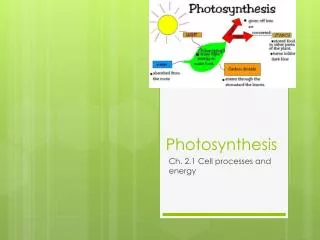
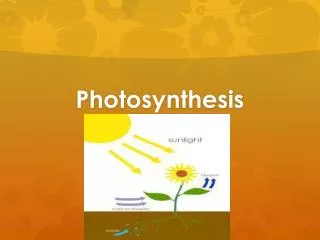
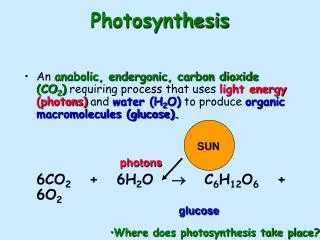
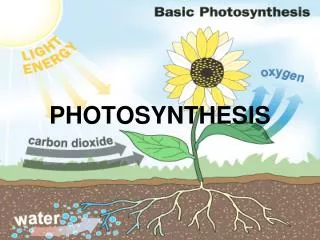
Photosynthesis equation Sunlight + CO2 + H2O -> Sugar + O2 • ****Know this for the test**** Sunlight
Photosynthesis • Photosynthesis happens in two main stages • Light Reaction (occurs in the thylakoid membranes) • Converts the energy in sunlight into chemical energy(ATP)
Photosynthesis 2. Calvin Cycle (stroma) • Uses chemical energy and CO2 + H to make sugar • Sugar then goes into cellular respiration so the cells can do work.
H H
Light energy • Sunlight is a form of electromagnetic energy • Travels in wave form • Wavelength: The distance between two adjacent waves
Light Energy Electromagnetic Spectrum: The range of types of electromagnetic energy from short to long wavelengths.
Pigments • Pigment: A chemical compound giving a substance color. • When light hits a pigment it has three options • Absorbed • Transmitted • Reflected
Chloroplast Pigment • A chloroplasts pigment chlorophyll: • Absorbs Blue-violet and red-orange light and convert it to energy • Reflects Green light leading to the leaf being green
Light Cycle Inputs Outputs O2 gas to environment H+ to Stroma ATP • Sunlight • H2O
Calvin Cycle Inputs Outputs Sugar • CO2 • ATP • H+
Results • Photosynthesis takes in sunlight, CO2, and H2O • Releases O2 and sugar • Sugar and O2 go into cells to complete cellular respiration