Optimizing Carbon Dioxide Production from Vinegar and Baking Soda Reaction
This lab experiment aims to determine the optimal molar ratio of vinegar (acetic acid) and sodium bicarbonate (baking soda) to produce the maximum amount of carbon dioxide (CO2) gas. By measuring the amounts of reactants and observing the resulting gas production, we will hypothesize the best ratio based on mathematical calculations. Various trials will be conducted, recording data rigorously to ensure accurate results. Through analysis and graphical representation of our findings, we will gain insights into the chemistry behind this reaction.

Optimizing Carbon Dioxide Production from Vinegar and Baking Soda Reaction
E N D
Presentation Transcript
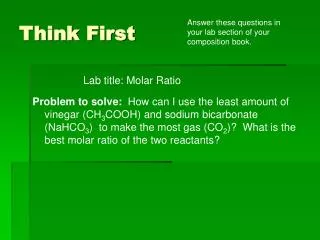
Think First Answer these questions in your lab section of your composition book. Problem to solve: How can I use the least amount of vinegar (CH3COOH) and sodium bicarbonate (NaHCO3) to make the most gas (CO2)? What is the best molar ratio of the two reactants? Lab title: Molar Ratio
Make a hypothesis: How many grams of sodium bicarbonate and mL vinegar will make the most gas? Base this answer on mathematical calculations. (an educated guess) Important Ideas to Consider The Vinegar will come in a 1.0 mol per liter solution There is a reaction between vinegar (acetic acid) and sodium bicarbonate (baking soda) solid to produce carbon dioxide gas, water, and sodium acetate. All substances (products and reactants) can and should be measured and recorded. • After getting into groups of 3 or 4… • 1. Make a blank data table. What will you be recording? • 2. Make an ongoing materials list. Gather Materials and write down what you use. Add to this list as you use more stuff. Make sure to record the size of the materials you use. • 3. Write your procedures as you do them. • Don’t use more than 10mL vinegar or 3g Sodium Bicarbonate per trial. • Repeat trials when needed. • Goal for trials: At least 4 different mole ratios, each one repeated at least once • 4. Do the procedure and fill out your data table.
Molar Ration lab continued… • Graph • Make the type of graph that best fits your data. You do not have to include all data points on your graph. • Extra Conclusion Questions: • What is the product made besides water and CO2. What is the chemical formula of this product? • What is the balanced equation of this reaction?