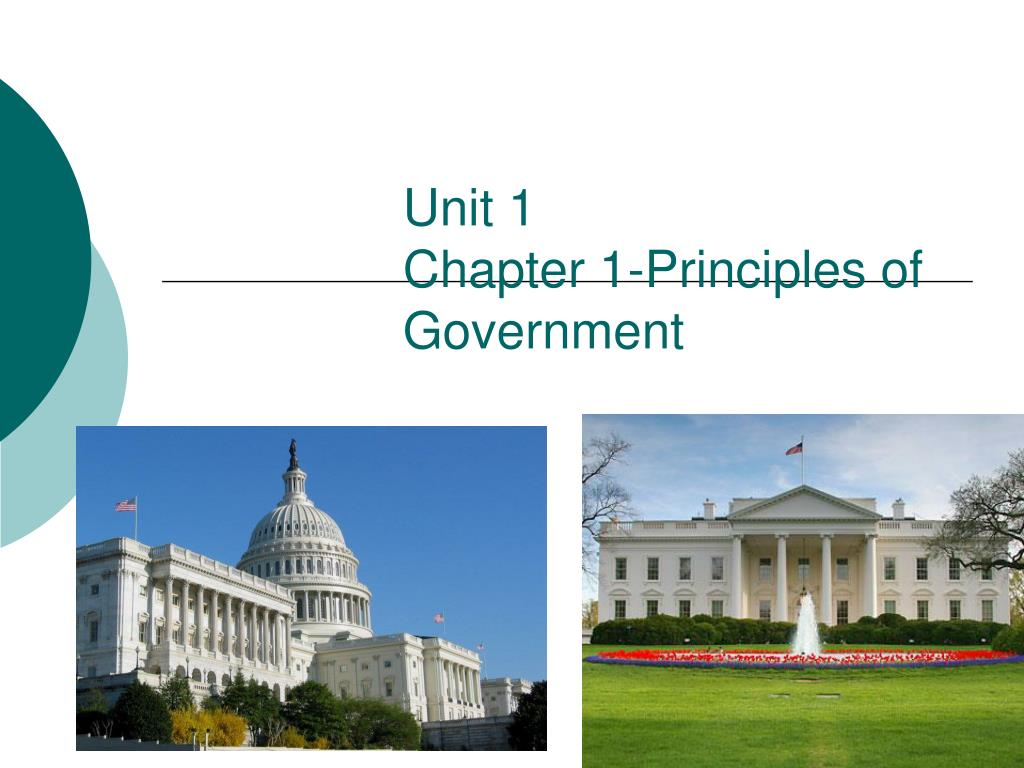
Unit 1Chapter 1-Principles of Government
What is Government? • Institution through which a society makes and enforces its public policies and laws • “Man is by nature a political animal-Aristotle • Public Policies: • All things government decides to do • Taxation, defense, education, crime, health care, working conditions etc.
Kinds of Power • Legislative • Power to make law and frame public policies • Executive • Power to execute, enforce, and administer law • Judicial • Power to interpret laws • Powers may be held by a single person or small group and majority of people • Powers are outlined in a country’s constitution
The State What is a state? • Body of people, living in a defined territory, organized politically, and with the power to make and enforce law without the consent of any higher authority • More than 190 states in the world
Characteristics of a State Four Characteristics: • Population: must have people • Territory: Must have land with recognized boundaries • Sovereignty: Has supreme and absolute power within its own territory • Government: Every state has a Government
Theories on Gov’t Development • 1-Force • military • 2-Evolutionary • Starts with family—clan---tribe • 3-Divine Right • “god given” right to rule • 4-Social Contract • John Locke
What does Gov’t do for us? • “We the People of the United States, in Order to form a more perfect Union, establish Justice, insure domestic Tranquility, provide for the common defense, promote the general Welfare, and secure the Blessings of Liberty to ourselves and our Posterity, do ordain and establish this Constitution for the United States of America.” -Preamble to the Constitution
What does Gov’t do for us? • 6 Functions • 1) Perfect Union: union=strength • 2) Establish Justice: law must be reasonable, fair and impartial • “equal justice for all” • 3) Domestic Tranquility: need order, need Gov’t • 4) Common Defense: must protect and defend our nation • 5) Promote General Welfare: Benefit the citizens • 6) Secure the Blessings of Liberty • “You can only be free if I am free”--Darrow
Forms of Government • No two governments are alike • Various ways to classify Governments • Who can participate in governing process • Geographic distribution of power • Relationship between lawmaking and executive
Democracy Political authority rests with people “Government of the people, by the people, for the people” Lincoln Direct Democracy will of people is translated into law directly by the people (mass meetings) Indirect/ Representative Democracy Small group of people chosen by the people act as their representative and express the popular will Forms of Government Cont.Who can participate?
Dictatorship Political authority rests with one person or a small group Oldest form of government Very few admit they are a dictator Autocracy Single person holds unlimited power Oligarchy Small group of people Forms of Government Cont.Who can participate?
Forms of Government Cont.Geographic Distribution • Unitary Government- centralized Gov’t • Great Britain • Federal Government- powers divided between central and local governments • United States • Confederate Government- alliance of independent states • European Union, Colonies
Geographic Distribution Confederate Government Unitary Federal Government
Forms of Government Cont.Relationship between Legislative and Executive Branches • Presidential (US) • Separation of Powers • Branches are independent • Fixed Terms • Powers are written in the Constitution • Parliamentary • Executive is made up of prime minister & cabinet • Parliament includes executive • No terms • No checks and balances • Majority of world is parliamentary
Democracy is…..
Political Cartoon #1 Title: democracy Artist: Petar Pismestrovic, Kleine Zeitung, Austria Date: February 2, 2005
Political Cartoon #2 Title: Meaning of Democracy Artist: Larry Wright, The Detroit News Date: February 1, 2005
Political Cartoon #3 Title: Democracy Shuttle Artist: Stephane Peray, Thailand Date: August 10, 2005
Characteristics of Democracy Majority rule Govt. by and for the people Everyoneequal under the law DEMOCRACY Elected representatives carry out the people’s will Rights of the individual protected Freedom
Democracy is …. a system of government in which the people rule either directly or through elected representatives
Direct Democracy • A form of democracy in which the people as a whole make direct decisions, rather than having those decisions made for them by elected representatives
Examples of Direct Democracy Should District 128 raise taxes? Yes No referendum - the practice of submitting a law to a popular vote at election time. The law may be proposed by a voter's initiative or by the legislature
Examples of Direct Democracy recall -A procedure whereby the voters can vote to remove an elected official from office
Representative Democracy • People elect individuals to represent their views at local, state and national levels • Public Policies (laws) are made by officials who are selected by voters • Held accountable by elections
American Concept of Democracy • Importance of the Individual • Equality of all individuals • Majority Rule, Minority Rights • Necessity of Compromise • Individual Freedom
Some folks are born made to wave the flag, ooh, they're red, white and blue. And when the band plays "Hail To The Chief", oh, they point the cannon at you, Lord,It ain't me, it ain't me,I ain't no senator's son,It ain't me, it ain't me,I ain't no fortunate one, no, Some folks are born silver spoon in hand,Lord, don't they help themselves, oh.But when the taxman come to the door,Lord, the house look a like a rummage sale, yes,It ain't me, it ain't me,I ain't no millionaire's son. It ain't me, it ain't me,I ain't no fortunate one, no.Yeh, some folks inherit star spangled eyes,ooh, they send you down to war, Lord,And when you ask them, how much should we give,oh, they only answer, more, more, more, yoh,It ain't me, it ain't me,I ain't no military son,It ain't me, it ain't me,I ain't no fortunate one,It ain't me, it ain't me,I ain't no fortunate one, no no no,It ain't me, it ain't me,I ain't no fortunate son, no no no, Fortunate Sonrecorded by Creedence Clearwater Revival (1969)