Download
1 / 23
230 likes | 354 Vues
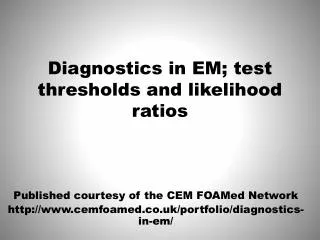
This resource from the CEM FOAMed Network explores the importance of test thresholds and likelihood ratios in emergency medicine diagnostics. It discusses how every patient assessment involves testing, emphasizing the significance of appropriate testing above and below defined thresholds. The content addresses the likelihood of correct diagnoses at various thresholds, the implications of negative and positive likelihood ratios, and the role of factors like cardiac risk in diagnosis. Ultimately, it seeks to improve patient outcomes through informed testing decisions.

E N D
Diagnostics in EM; test thresholds and likelihood ratios Published courtesy of the CEM FOAMed Network http://www.cemfoamed.co.uk/portfolio/diagnostics-in-em/
Everything we do in a patient assessment is a testIncluding questions we ask
Below a test threshold;more likely to harm than help a patient by testing
Above a test threshold; more likely to harm than help a patient by testing
How do we use all of this information?? 100 % Likelihood of diagnosis being correct Diagnosis considered Below test threshold 0%
How do we use all of this information?? 100 % Above test threshold Likelihood of diagnosis being correct Diagnosis considered 0%
How do we use all of this information?? 100 % Above test threshold Appropriate testing Likelihood of diagnosis being correct Diagnosis considered Below test threshold 0%
Application of serial tests 100 % Finding 3 Above test threshold Finding 2 Likelihood of diagnosis being correct Finding 1 Diagnosis considered Below test threshold 0%
Correct testingCorrect testCorrect circumstanceCorrect patient
Perry et al. Sensitivity of coputed tomography performed within six hours of onset of headache for diagnosis of subarachnoid haemorrhage: prospective cohort study. BMJ 2011; 343:d4277 doi. 10.1136/bmj.d4277
Han et al., The Role of Cardiac Risk Factor Burden in Diagnosing Acute Coronary Syndromes in the Emergency Department Setting. Ann Emerg Med. 2007; 49
Who not to test 100 % Likelihood of diagnosis being correct Diagnosis considered Below test threshold 0%
Who not to test but to treat 100 % Above test threshold Likelihood of diagnosis being correct Diagnosis considered 0%
Who should be tested 100 % Appropriate testing Likelihood of diagnosis being correct Diagnosis considered 0%
Correct testingCorrect testCorrect circumstanceCorrect patient