Command Line Arguments
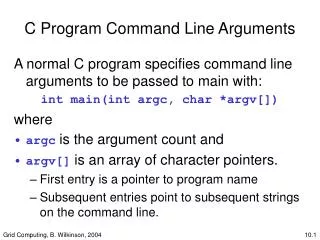
This guide provides an overview of how to pass and process command line arguments in C and C++. It covers the essential concepts of `argc` and `argv`, detailing how command line parameters are passed to the `main` function. Each argument is stored in a character array and can be accessed by index. The first argument is always the program name, and the remaining arguments follow. The guide also includes a sample code snippet demonstrating the output for various input arguments, along with the conventions of argument passing.

Command Line Arguments
E N D
Presentation Transcript
Command Line Arguments Dr. David A. Gaitros COP3330 Fall Term 2008
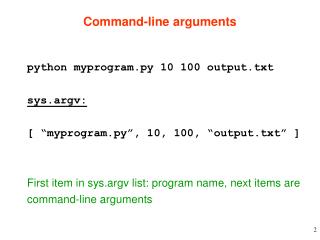
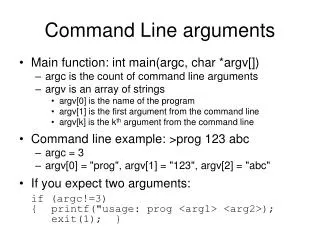
C/C++ Command Line Arguments • When executing a program in either C or C++ there is a way to pass command line arguments. • Passed a character arrays. • Each parameter separated by a space • Comes into the program as two arguments • argc – Number of parameters • argv – Parameter list
Command Line Arguments #include <iostream> using namespace std; int main(int argc, char *argv[]) { for (int i=0; i<argc; i++) cout << “This is Argument number #” << i << “->” << argv[i] << endl; return 0; }
Sample Output Gaitros>hello Each word should be a unique argument • This is Argument number #0 -->hello • This is Argument number #1 -->Each • This is Argument number #2 -->word • This is Argument number #3 -->should • This is Argument number #4 -->be • This is Argument number #5 -->a • This is Argument number #6 -->unique • This is Argument number #7 -->argument
Command Line Arguments Conventional rules: • Arguments are always passed to main( ). • There must be two • first is an integer • second char pointer to an array • First argument (argv[0]) will always be the name of the calling program. • argc will always be at least 1 • The first argument is always argv[0] • The last argument is always argv[argc-1] • argv[argc] will always be a null pointer • Arguments are always passed as character strings. Numbers must be converted from characters to integers, floats, doubles, etc.