Download
1 / 7
70 likes | 203 Vues
This overview discusses renewable energy initiatives at UCSC, led by the Sustainability Office. It includes insights on carbon offset options, renewable energy credits (RECs), and the associated pros and cons of each. While UCSC aims to green the grid with a 10 MW target by 2014, challenges like high costs, bureaucracy, and local impact concerns remain. The article evaluates on-site energy production, power purchasing agreements, and the role of energy efficiency as a vital part of the clean energy landscape.

E N D
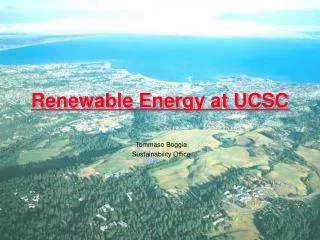
Renewable Energy at UCSC Tommaso Boggia Sustainability Office
On-site Carbon Offsets Options • Renewable energy credits (www.iesolar.com) (www.ran.org) (www.kansastravel.org)
Cons: Expensive $5/Watt Bureaucracy Max 2 year payback Sad, sad history Solar Hot Water Location Trees Fog Pro: Power Purchasing Agreement UCSC policies 10 MW by 2014 UCSC Farm & Garden Location Buildings Meadows? On-Site at UCSC (www.ucsc.edu)
Pros Green the grid Third party certification Financial incentive Media favorite Cons Negligible local effect Greenwash Indulgence Renewable Energy Credits (www.sterlingplanet.org)
Pros Can be administered locally Easier to grasp Include all type of emissions (transit, etc) Cons No standard certification Lots of scams Dubious methods “The study finds little or no climate benefit when trees are planted in temperate regions.” Double dipping Cheat Neutral Carbon Offsets (www.americanforests.org)
RECs ‘Virtually’ eliminate our emissions Energy Efficiency Cheapest form of clean energy Three Phases (eere.energy.gov) • On-site, decentralized energy production • Produce as much energy as we can to supplement greening grid
Contact: Tommaso Nicholas Boggia Focus the Nation Event Coordinator tboggia@ucsc.edu