Understanding Free Fall and Terminal Velocity in One-Dimensional Motion
This overview explores the principles of one-dimensional vertical motion in free fall, focusing on objects dropped from a planet's surface in the absence of air resistance. We examine the acceleration due to gravity (g = -9.8 m/s²) and its effect on all objects on Earth. Additionally, we define air resistance and terminal velocity, highlighting how terminal velocity is achieved when air resistance balances gravitational force, resulting in constant speed. This resource includes credible sources for further understanding.

Understanding Free Fall and Terminal Velocity in One-Dimensional Motion
E N D
Presentation Transcript
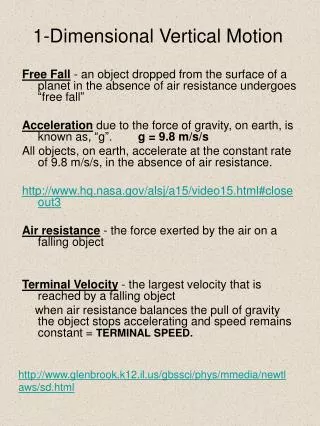
1-Dimensional Vertical Motion Free Fall - an object dropped from the surface of a planet in the absence of air resistance undergoes “free fall” Acceleration due to the force of gravity, on earth, is known as, “g”. g = -9.8 m/s/s All objects, on earth, accelerate at the constant rate of -9.8 m/s/s, in the absence of air resistance.
Air resistance - the force exerted by the air on a falling object
Terminal Velocity - the largest velocity that is reached by a falling object when air resistance balances the pull of gravity the object stops accelerating and speed remains constant = TERMINAL SPEED.
sources • http://www.physicsclassroom.com/mmedia/newtlaws/sd.cfm • http://www.youtube.com/watch?v=kNED5RzqxOo http://www.hq.nasa.gov/alsj/a15/video15.html#closeout3 • http://www.hq.nasa.gov/alsj/frame.html