The Enlightenment Influence: Declaration of Independence by Thomas Jefferson
Exploring Thomas Jefferson's foundational document, divided into three main parts justifying revolution, condemning King George's tyranny, and declaring independence. Influenced by John Locke's Social Contract Theory. Emphasizes life, liberty, and property rights. Ends with a call for international aid from France via Benjamin Franklin.

The Enlightenment Influence: Declaration of Independence by Thomas Jefferson
E N D
Presentation Transcript
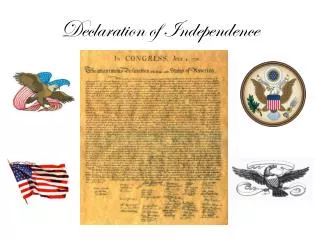
Declaration of Independence Written by Thomas Jefferson
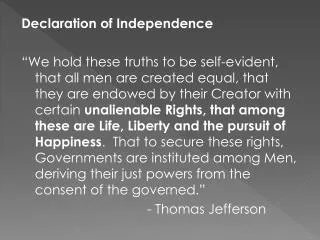
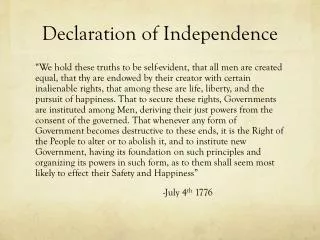
Declaration of Independence • Divided into 3 main parts Part I • Jefferson begins by legally and philosophically justifying the revolution • The second passage shows the influence of the enlightenment and John Locke
John Locke • an English philosopher • Wrote Two Treatise of Government (1690) • Locke argued that if a government does not allow its citizens to enjoy certain rights and freedoms, the people have a right to replace that government – Social Contract Theory • “Life, liberty, and property”
Part II • Thomas Jefferson condemns the behavior of King George and lists many of his tyrannical actions that forced his American subjects to rebel • How many “He has” are there in this section
Part III • The official declaration of independence • The colonists made sure to clearly express that they were not rebels but a free people with all the powers of an independent nation. • A way to secure international aid • Benjamin Franklin would leave for France to secure French aid