Download
1 / 14
140 likes | 249 Vues
This document reviews the implementation of Repeated-Measures ANOVA to investigate memory scores among subjects exposed to three different study sequences. It entails calculating the sum of squares between groups (SStreatment) and within groups (SSresidual), as well as performing hypothesis testing to determine if group means are reliably different. The analysis encompasses the challenges posed by individual differences and provides detailed calculations necessary to partition variability and assess treatment effects.

E N D
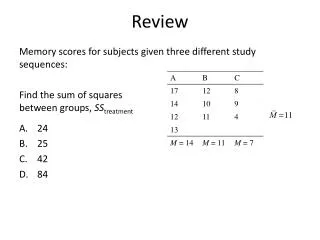
Review Memory scores for subjects given three different study sequences: Find the sum of squares between groups, SStreatment • 24 • 25 • 42 • 84
Review Memory scores for subjects given three different study sequences: Find the sum of squares within groups, SSresidual • 14 • 30 • 104 • 114
Review Memory scores for subjects given three different study sequences: SStreatment = 84SSresidual = 30 dftreatment = 2 dfresidual = 7 Calculate F, for testing whether the group means are reliably different • 0.8 • 1.25 • 9.8 • 180
Repeated-Measures ANOVA 11/12
Repeated-Measures Design • Multiple measurements for each subject • Different stimulus types, conditions, times, etc. • All measurements are of the same variable, but in different situations • Generalizes paired-samples design • Is there an effect of the treatment? • Variation due to condition, time, stimulus, etc. • Do the means of the measurements vary? • Same null hypothesis as simple ANOVA • m1 = m2 = … = mk
Repeated-Measures Data • Individual differences • Variation from one subject to another • Affects all the scores of any given subject
Accounting for Individual Differences • Individual differences complicate hypothesis testing • Inflate variability of scores • Don’t affect random variability of treatment means • Contribute to all measurements equally • Basic idea • Subtract subject mean for each score • Do simple ANOVA on these differences (dfresidual changes)
Partitioning Variability • Break total variability into treatment, subjects, and residual error • Total variability • Same as before: • Variability due to treatment • Same as before: • Variability due to individual differences • Same idea as SStreatment • Variability of subject means: • Residual variability • Remaining variability • Can calculate directly, but not intuitive
Repeated-Measures ANOVA • Does treatment explain significant portion of variability? • Don't want to penalize for variability due to individual differences • Removing SSsubject reduces SSresidual and makes it a fair comparison • Hypothesis test for repeated-measures ANOVA: • Same as regular ANOVA, except we first remove SSsubject • (SSsubject not meaningful with simple ANOVA because each subject is only in one group) SStotal
Degrees of Freedom dftreatment=k – 1 SStotal dftotal=nk – 1 dfsubject=n – 1 dfresidual= nk – 1 – (k–1) – (n–1) =nk– n – k + 1 .
Review Coffee drinkers are given arithmetic tests on 3 different days: one after drinking coffee, one after decaf, and one with nothing. Find the sum of squares for individual differences, SSsubject • 152 • 558 • 1674 • 2232
Review Coffee drinkers are given arithmetic tests on 3 different days: one after drinking coffee, one after decaf, and one with nothing. SStotal = 1860 SStreatment = 152 SSsubject = 1674 SSresidual = 34 What would SSresidual be if these were 12 unrelated subjects? • 34 • 186 • 1708 • 1826
Review Coffee drinkers are given arithmetic tests on 3 different days: one after drinking coffee, one after decaf, and one with nothing. SStotal = 1860 SStreatment = 152 dftreatment = 2 SSsubject = 1674 dfsubject = 3 SSresidual = 34 dfresidual = 6 Find the F statistic for testingdifferences across conditions • 0.14 • 13.41 • 98.47 • 111.88