Investigating Hematite Nanoparticles in Cosmetics: Characterization and Bioactivity Insights
This project focuses on the unique characterization of hematite nanoparticles (NPs) in cosmetics, emphasizing their bioactive properties and interaction with biosystems. It seeks to understand how different nanomorphologies affect adsorption sites and acid-base properties using in-situ spectroscopic techniques. We aim to determine the influence of NP size on the selectivity of carbonate adsorption and explore the implications for protein interactions. Results will enhance our understanding of nanoparticle behavior in cosmetic applications and their potential effects on human health.

Investigating Hematite Nanoparticles in Cosmetics: Characterization and Bioactivity Insights
E N D
Presentation Transcript
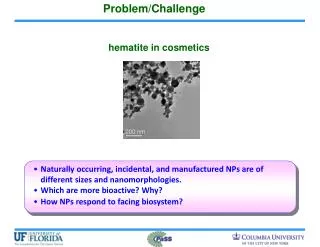
Problem/Challenge hematite in cosmetics • Naturally occurring, incidental, and manufactured NPs are of different sizes and nanomorphologies. • Which are more bioactive? Why? • How NPs respond to facing biosystem?
Problem/Challenge Nel, Madler, Velegol, Xia, Hoek, Somasundaran, Klaessig, Castranova, Thompson Nature Mat. 8, 2009, 543
‘Appropriate’ Characterization of NP, protein, system Why This Project is Unique? • In situ probing of • anisotropy in acid-base properties of adsorption sites on metal oxide nanoparticles (NP) in contact with water =LOCAL PROPERTIES IN SITU (!) • molecular structure and binding mode of adsorbed species Interpretation of Data Using Molecular Modeling
Molecular Modeling: Chrysotile (Mg3Si2O5(OH)4) – Human Serum Albumin Artali et. al., J. R. Soc. Interface 2008, 5, 273 Latin: albus = white Modeled Domains of HSA Domains of HSA • Modification of HSA secondary structure • Loss of α-helix structure • Amino acid monolayer on chrysotile surface
Objective of Initial Part of Project • To develop • in situ probe-molecule spectroscopic method to compare acid-base properties of different adsorption sites on basic metal oxide nanoparticles (NPs)
Samples: Hematite and Ferrihydrite NPs H200 H38 H20 H7 Hematite H45 H600 H120 2-Line Ferrihydrite 7, 20, 38, 45, and 120 nm hematite was synthesized by forced hydrolysis; 200 nm hematite and 2-line ferrihydrite – commercial; phase purity was confirmed by XRD
Effect of Nanomorphology on Average Acid-Base Properties of Hematite NPs Isoelectric point (IEP) by electrokinetic measurements; Point of Zero Charge (PZC) – by salt titration Macroscopic basicity has maximum at ~40nm It averages acid-base properties of different surface sites
Adsorption of carbonate vs hematite NPs size/morphology I I II II II FH: one type of adsorbed CO32- 7-45 nm: two types of CO32- 120 nm: HCO3- dominates 200 nm: no adsorption 3O–C–O Fe-OH, 2Fe-O III III two-magnons abs-n CO32- adsorption is SPECIFIC to NP size in situ FTIR HATR spectra NPs at pH of 5.6 in situ FTIR HATR spectra NPs at pH of 5.6 1 3as 3s I
I inner-sphere monodentate mononuclear (ISMM) I I I II II II inner-sphere bidentate binuclear (ISBB) II III III protonated inner-sphere monodentate mononuclear (ISMM-H) III DFT molecular modeling => structure of adsorbed complexes Selective adsorption of CO32-: basicity of terminal hydroxyls
Conclusions • Carbonate adsorption is SPECIFIC for NP size • Selectivity can be correlated with size induced changes in surface structure and basicity of terminal hydroxyls • Heterogeneity in acid-base surface properties of NPs can be characterized using carbonate as a probe molecule • These findings are key to unraveling complex interactions with polypeptides and proteins
Acknowledgements Work was supported by NSF grant #0925232