Understanding Modern Taxonomy: Classifying Life and its Evolutionary Relationships
This comprehensive overview of modern taxonomy explains how life is classified today. By examining traits that indicate common ancestry, phylogeny, and molecular data, scientists can understand the evolutionary histories of species. Fossils and biochemical evidence reveal relationships among different organisms, confirming or challenging traditional classifications. Key concepts like homologous structures, cladistics, and clades are defined, emphasizing the importance of shared characteristics in constructing evolutionary trees. This knowledge is essential for grasping the interconnectedness of life on Earth.

Understanding Modern Taxonomy: Classifying Life and its Evolutionary Relationships
E N D
Presentation Transcript
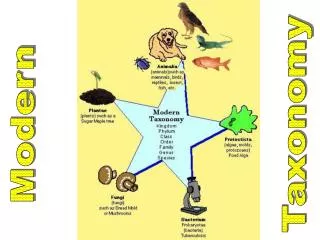
Modern Taxonomy
How is Life Classified Today? • Similar traits often indicates common ancestry • Phylogeny (fahy-loj-uh-nee): evolutionary histories a species • Determined by examining: • Fossils • Living specimens • Molecular data • Development Domain Eukarya Kingdom Animalia Phylum Chordata Family Mammalia Despite the physical differences, which taxondo these belong to?
Fossil Evidence • Homologous structures: body parts that have a similar structure, but different function • Relationships identified among different species • Fossils link past life to modern life
Anatomy shows nonrelationships also Dolphins are not FISH! Despite their outer Physical appearance
Biochemical Evidence • Comparing DNA, amino acids, chromosomes, proteins • Similarities and differences can be found • Splits in evolution can be estimated
Chromosome Evidence Chromosome order: Human, orangutan, gorilla, pygmy chimp
Molecular evidence reveals species’ relatedness. • Molecular data may confirm classification. • Molecular data may lead scientists to propose a new classification. • DNA is usually given the last word by scientists.
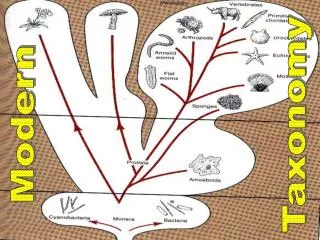
Cladistics • Cladistics is a common method to make evolutionary trees. • classification based on common ancestry • species placed in order that they descended from common ancestor • Shown in tree branching diagrams
1 Tetrapoda clade 2 Amniota clade 3 Reptilia clade 4 Diapsida clade 5 Archosauria clade FEATHERS & TOOTHLESS BEAKS. SKULL OPENINGS IN FRONT OF THE EYE & IN THE JAW OPENING IN THE SIDE OF THE SKULL SKULL OPENINGS BEHIND THE EYE EMBRYO PROTECTED BY AMNIOTIC FLUID FOUR LIMBS WITH DIGITS DERIVED CHARACTER • A clade is a group of species that share a common ancestor. • Derived characters are traits shared in different degrees by clade members. CLADE • basis of arranging species in cladogram • more closely related species share more derived characters • represented on cladogram as hash marks • Nodes represent the most recent common ancestor of a clade. NODE
List 2 characteristics of a salamander. Where would a 3rd be located? • From the diagram, which organism is most closely related to the Chimp?
1) What does an amphibian & crocodile have in common? Vertebrae, Bony skeleton, Four limbs • 2) List the traits of a ray-finned fish. Doesn’t have 4 limbs, has bony skeleton, has vertebrae