The Enlightenment
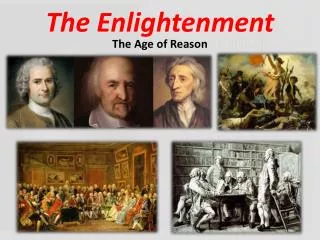
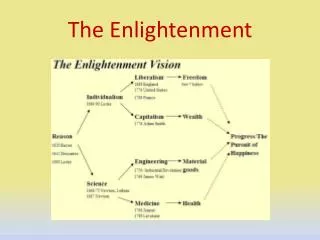
The Enlightenment was an intellectual movement promoting reason, secularism, and social progress. Key figures like Kant, Voltaire, Montesquieu, Rousseau, and Diderot challenged traditional beliefs and advocated for individual rights, religious tolerance, and legal reforms. They encouraged the education of the masses and a focus on rational thought, which laid the groundwork for modern democracy and capitalism. Enlightenment salons, often hosted by women like Madame Geoffrin, played a vital role in the discourse of ideas. This period reshaped societal views and emphasized freedom, tolerance, and the pursuit of knowledge.

The Enlightenment
E N D
Presentation Transcript
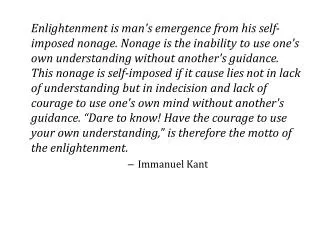
Immanuel Kant: • “Dare to Know! Have the courage to use your own intelligence!”
Origins: Periods: • Renaissance • Reformation • Scientific Revolution • Newton • Locke
Characteristics: • Reason: Rational Thought • Secularism • Social Progress • Education of the Masses • Freedom and Liberty • Tolerance • Legal Reform • Laws of Nature!
Philosophes: • Who where they? • Common bonds • Students of society who analyzed its evils and advanced reforms. • Skepticism • Cultural Relativism
Voltaire:(1694-1778) • Advocated religious toleration • Deism: existence of a “mechanic” who had created the universe • World ran according to natural law
Voltaire’s Wisdom • Every man is guilty of all the good he didn’t do. • Judge a man by his questions rather than by his answers. • Men are equal; it is not birth, but virtue that makes the difference • It is dangerous to be right when the government is wrong. • Love truth and pardon error. • The way to become boring is to say everything. • I may not agree with what you have to say, but I will defend to the death your right to say it.
Montesquieu: (1689-1755) The Spirit of Laws: 1748 The Persian Letters: 1721 • Attacks traditional religion • Advocates religious toleration • Denounces slavery • Focus: use of reason • “Natural Laws” governing society • Separation of powers • Executive • Legislative • Judicial
Rousseau: (1712-1778) • Man is born free, but everywhere he is in chains.
The Social Contract 1762 • Social Contract • General Will • Liberty: achieved by being forced to follow what was best for all people. • Freedom: adherence to laws one has imposed on oneself • Principles of a Democracy
Adam Smith Economic Liberty: • Free trade • Laissez-faire • The Wealth of Nations: 1776 • 1. Law of Self- Interest • 2. Law of Competition • 3. Law of Supply and Demand
The Salon • Philosophes and guests engaged in conservations and spread the ideas of the Enlightenment • Run by wealthy women in urban areas • Reputation of salon depended upon the stature of males a hostess could attract • Females influence decision making and literary and artistic taste
Role of Women • Mary Wollstonecraft: Vindication of the Rights of Women: 1792 • British • Women obeying men same as monarchs have absolute power over their subjects • Reason innate in all humans- women entitled to the same rights as men in education and political life
Diderot • Attempts to summarize the state of knowledge • Freedom of thought and expression • Progress through knowledge
Encyclopedia • First published 1751 • 28 Volumes • Illustrated • Cross-Referenced
Zoology & Biology A dissection at the Royal Academy, London.