
SlideServe
Menu
Préférences
© SlideServe · v2026

Living Things and Their Needs

thane avatar
13 diapositives · 1.2K Views · Feb 07, 2012

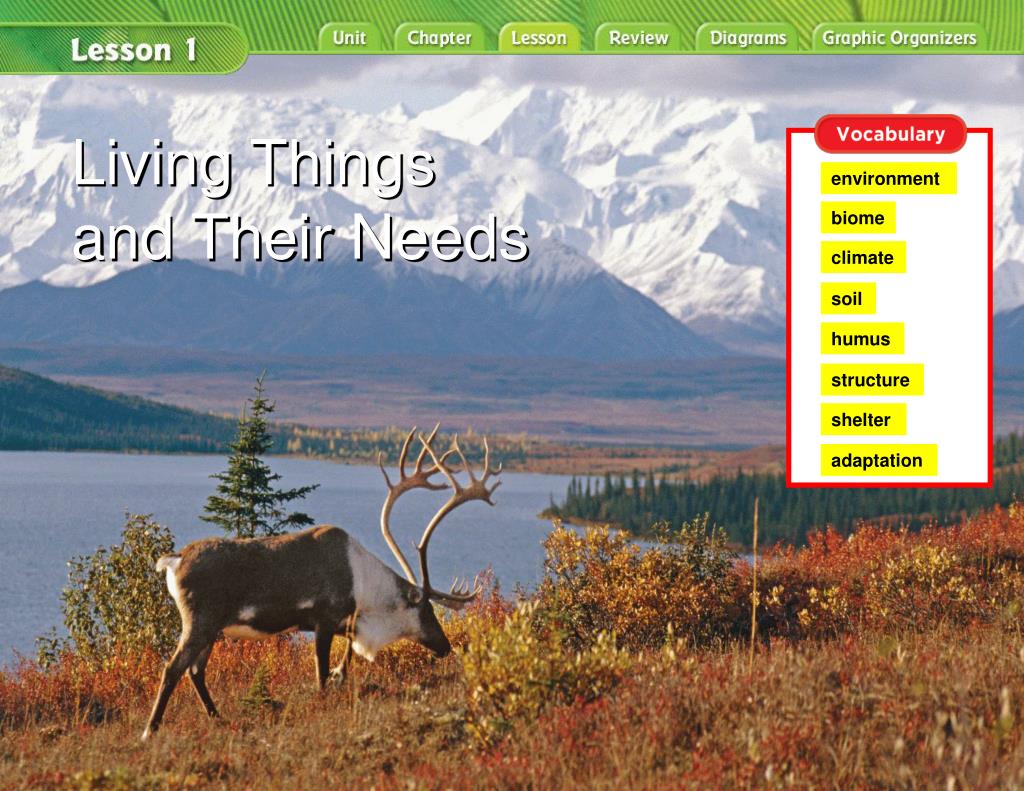
Living Things and Their Needs. Living Things and Their Needs. environment. biome. climate. soil. humus. structure. shelter. adaptation. environment. biome. environment (en v ī´rən mənt) All the living and nonliving things that surround a living thing. climate. soil. humus.
Living Things and Their Needs - slide 1
01 / 13Living Things and Their Needs
1 / 17

Télécharger la présentation

Living Things and Their Needs
Une image / un lien ci-dessous est fourni (tel quel) pour télécharger la présentation

Politique de téléchargement : le contenu du site vous est fourni TEL QUEL pour votre information et votre usage personnel ; il ne peut être vendu, concédé sous licence ni partagé sur d’autres sites sans l’accord de son auteur.Le contenu vous est fourni TEL QUEL, pour votre information et votre usage personnel uniquement. Téléchargez la présentation en cliquant sur ce lien. Lors du téléchargement, si vous ne parvenez pas à télécharger une présentation, l’éditeur a peut-être supprimé le fichier de son serveur.Pendant le téléchargement, si vous ne parvenez pas à obtenir une présentation, le fichier a peut-être été supprimé par l’éditeur.

F I N

Plus de contenu associé

Transcription de la présentation
  1. Living Things and Their Needs Living Things and Their Needs environment biome climate soil humus structure shelter adaptation

  2. environment biome environment (en vī´rən mənt)All the living and nonliving things that surround a living thing. climate soil humus biome (bī´ōm)An area of land or water that has certain kinds of living and nonliving things. soil (soil)A mixture of tiny rock particles, minerals, and decayed plant and animal matter. climate (clī´mit)The average weather patterns of a region. humus (hū´məs)Leftover decomposed plant or animal material in soil. Where do living things live? Where do living things live?

  3. Biomes This camel lives in a desert. Deserts are biomes that have dry climates and sandy soil. Deserts can be hot or cold.

  4. structure structure (strək´chər) A thing that is developed or built for a particular use. How do plants get what they need? stems leaves roots

  5. shelter shelter (shel´tər) A place or object that protects an animal and keeps it safe. How do animals get what they need? gills

  6. adaptation adaptation (a´dap´tā´shən) A special trait that helps a living thing survive in its environment. What helps living things survive in their environments?

  7. Review Main Idea What are adaptations and how do they help living things survive? An adaptation is a special feature or behavior that helps a living thing survive. This bear’s claws are an adaptation that help it catch fish.

  8. Review Main Idea How do living things get what they need from their environments? Living things have structures that help them get what they need from their environments.

  9. Review Draw Conclusions Could a redwood tree survive in the desert? Text Clues Conclusions Redwoods grow along the California coast. Redwoods are normally found along the coast. Here the cool, damp climate and rich soil are just right for them to grow. The desert’s warm, dry climate and sandy soil will not allow the redwood tree to survive in the desert.

  10. Review Vocabulary Match each word with its definition. environment humus climate biome A) the average weather patterns of a region B) broken-down plant and animal material C) an area of land or water that has certain kinds of living and nonliving things D) everything that surrounds a living thing

  11. Review Vocabulary Match each word with its definition. adaptation structure soil shelter A) a place or object that protects an animal and keeps it safe B) a thing that is developed or built for a particular use C) a mixture of tiny rock particles, minerals, and decayed plant and animal matter D) a special trait that helps a living thing survive in its environment

  12. Review Read a Diagram How do leaves help plants get what they need?