Smart Demand: Lessons from Water
150 likes | 267 Vues
This research explores the parallels between water consumption patterns and energy demand, particularly in the context of sustainable practices. It identifies key issues such as over-abstraction, rising domestic water demand, and the social practices that govern consumption behaviors. The study emphasizes that energy reduction strategies should focus on understanding and targeting habitual routines rather than merely relying on demographics and appliance usage data. The findings suggest that effective energy demand management requires sophisticated monitoring and an understanding of social practices.


Smart Demand: Lessons from Water
E N D
Presentation Transcript
Dr Ben Anderson b.anderson@soton.ac.uk Sustainable Energy Research Group Faculty of Engineering and the Environment Smart Demand:Lessons from Water
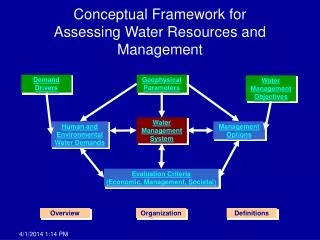
The Menu The problem(s) with water Water ‘practices’ The problem with ‘demographics’ Lessons from water Implications for smart energy Source: DEFRA, 2008
The problem(s) with water… Over abstraction It costs to clean Energy (carbon) Supply Patchy (no grid) Locally variable Demand poorly understood Source: DEFRA, 2011 With no action
What do we know? Domestic water demand is rising Mean daily consumption ~= 150 l/person/day ~= 140 l/person/day (2030)? More single households more total volume And Consumption = ƒ(occupancy) But look at the ranges! But that’s about it… Source: ESRC Sustainable Practices Group Water Survey, 2011 www.sprg.ac.uk Source: DEFRA, 2011
Well… almost ‘Expected’ appliance use On average Actual appliance consumption Mean l/day For a few micro-measured households So… Consumption = ƒ(occupancy) + ƒ(appliances) But Source: Shove & Medd, 2005
The trouble with averages… 5 ‘average’ households but they do different things So to reduce demand… What to target? Who to target? How to target them? Source: Shove & Medd, 2005 • Now… • Consumption = ƒ(occupancy * wpd) + ƒ(appliances * wpd) • Where wpd = What People Do
But what do people do? Does this tell us? Social practices Habits Routines Neither fully conscious nor reflective Constraints & inter-dependences “Why people don’t do what they ‘should’” (Jim Skea, 2011)
Washing practices 2011 survey N = 1800 “7 a week” 7 showers + 1 bath Do washing practices cluster? Source: ESRC Sustainable Practices Group Water Survey, 2011 www.sprg.ac.uk
Washing practice clusters Dimensions Frequency Diversity Technology Outsourcing Source: ESRC Sustainable Practices Group Water Survey, 2011 www.sprg.ac.uk Whole sample
Washing practice clusters Dimensions Frequency Diversity Technology Outsourcing Explain ~ 20% l/day variation Source: ESRC Sustainable Practices Group Water Survey, 2011 www.sprg.ac.uk
But… Cluster membership is not easy to predict
Lessons from water: Volume ~= ƒ(occupancy) + ‘Attitudes’ are not that relevant Appliances provide a substrate for… What people do - social practices Help to explain variation () Across ‘similar’ households With similar appliances And similar accommodation Are habitual, routine & not fully conscious nor reflective So difficult to change
Hot water! You can eco-tech all you like But it’s what people do with it that matters Implications for Energy H2 - low demand - little potential for shifting? H4 -high, peaky demand - potential for shifting? Source: A.S. Bahaj, P.A.B. James (2007) “Urban energy generation: The added value of photovoltaics in social housing” Renewable and Sustainable Energy Reviews 11: 2121-2136
Hot water! You can eco-tech all you like But it’s what people do with it that matters Smart Demand needs a handle on Habits, routines Barriers, constraints and flexibility Networks of demand And ways of ‘auto-targeting’ interventions That don’t rely on ‘demographics’ + ‘values’ Smart Monitoring? Implications for Energy
Thank you Dr Ben Anderson (b.anderson@soton.ac.uk) www.energy.soton.ac.uk SPRG Sustainable Practices Research Group www.sprg.ac.uk DANCER Digital Agent Networking for Customer Energy Reduction (EPSRC) dancerproject.wordpress.com