Download
1 / 1
10 likes | 138 Vues
This study explores the automatic detection and decomposition of activities from video data, specifically focusing on the Towers of Hanoi task. Using a parameterized stochastic grammar, we define activities via their actions rather than appearances. By parsing interaction events and incorporating feedback from high-level analyses, we enhance the interpretation of object identities. The approach maintains multiple hypotheses for object mapping, transforming general events into specific grammar terminals. While effective, it faces challenges in complex temporal constraints and recovery from errors.

E N D
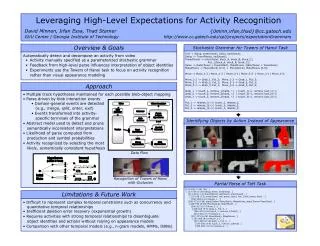
Identifying Objects by Action Instead of Appearance Overview & Goals • Automatically detect and decompose an activity from video • Activity manually specified as a parameterized stochastic grammar • Feedback from high-level parse influences interpretation of object identities • Experiments use the Towers of Hanoi task to focus on activity recognition rather than visual appearance modeling Stochastic Grammar for Towers of Hanoi Task ToH -> Setup, enter(hand), Solve, exit(hand); Setup -> TowerPlaced, exit(hand); TowerPlaced -> enter(hand, block_A, block_B, block_C), Put_1(block_A, block_B, block_C); Solve -> state(Tower = TowerStart), MakeMoves, state(Tower = TowerGoal); MakeMoves -> Move(block) [0.1] | Move(block), MakeMoves [0.9]; Move -> Move_1-2 | Move_1-3 | Move_2-1 | Move_2-3 | Move_3-1 | Move_3-2; Move_1-2 -> Grab_1, Put_2; Move_1-3 -> Grab_1, Put_3; Move_2-1 -> Grab_2, Put_1; Move_2-3 -> Grab_2, Put_3; Move_3-1 -> Grab_3, Put_1; Move_3-2 -> Grab_3, Put_2; Grab_1 -> touch_1, remove_1(hand, ~) | touch_1(~), remove_last_1(~); Grab_2 -> touch_2, remove_2(hand, ~) | touch_2(~), remove_last_2(~); Grab_3 -> touch_3, remove_3(hand, ~) | touch_3(~), remove_last_3(~); Put_1 -> release_1(~) | touch_1, release_1; Put_2 -> release_2(~) | touch_2, release_2; Put_3 -> release_3(~) | touch_3, release_3; Data Flow Recognition of Towers of Hanoi with Occlusion Partial Parse of ToH Task [113-739 (1-29) ToH . ] [113-739 (1-29) Setup, Solve, exit(hand) . ] [113-234 (1-4) TowerPlaced, exit(hand), enter(hand) . ] [113-169 (1-2) enter(hand, red, green, blue), Put_1(red, green, blue) . ] [169-169 (2-2) release_1 . ] [248-733 (5-28) state(Tower=TowerStart), MakeMoves, state(Tower=TowerGoal) . ] [248-733 (5-28) Move(block), MakeMoves . ] [248-315 (5-7) Move_1-3 . ] [248-315 (5-7) Grab_1, Put_3 . ] [248-270 (5-6) touch_1, remove_1(hand) . ] [315-315 (7-7) release_3 . ] [337-733 (8-28) Move(block), MakeMoves . ] [337-385 (8-10) Move_1-2 . ] [337-385 (8-10) Grab_1, Put_2 . ] [337-350 (8-9) touch_1, remove_1(hand) . ] [385-385 (10-10) release_2 . ] … Leveraging High-Level Expectations for Activity Recognition David Minnen, Irfan Essa, Thad Starner GVU Center / Georgia Institute of Technology {dminn,irfan,thad}@cc.gatech.edu http://www.cc.gatech.edu/cpl/projects/expectationGrammars Approach • Multiple track hypotheses maintained for each possible blob-object mapping • Parse driven by blob interaction events • Domain-general events are detected (e.g., merge, split, enter, exit) • Events transformed into activity- specific terminals of the grammar • Abstract model used to detect and prune semantically inconsistent interpretations • Likelihood of parse computed from production and symbol probabilities • Activity recognized by selecting the most likely, semantically consistent hypothesis Limitations & Future Work • Difficult to represent complex temporal constraints such as concurrency and quantitative temporal relationships • Inefficient deletion error recovery (exponential growth) • Requires activities with strong temporal relationships to disambiguate object identities and actions without relying on appearance models • Comparison with other temporal models (e.g., n-gram models, HMMs, DBNs)