Download
1 / 18
180 likes | 314 Vues
This work presents a comprehensive framework for modeling ontologies utilizing RDF(S). It distinguishes between light-weight and heavy-weight ontologies, addressing key components such as concepts, relation hierarchies, and various semantic entailments. The paper discusses the significance of axioms, their role in the Semantic Web, and presents tools like OntoEdit and Protege for effective ontology engineering. It emphasizes interoperability and the importance of defining application-specific languages and axioms. The paper is significant for researchers and practitioners in knowledge management and semantic technologies.

E N D
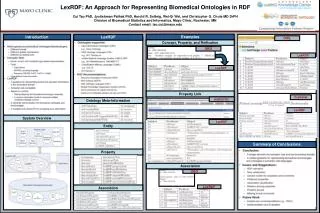
An Extensible Approach for Modeling Ontologies in RDF(S) Steffen Staab, Michael Erdmann, Alexander Mädche, & Stefan DeckerResearch Group Knowledge Management Institute AIFB, University of Karlsruhe, & DB Group, Stanford UniversityLisbon, September 21, 2000
RDF(S) What is an Ontology? • Light-weight Ontology • concepts, atomic types • is-a hierarchy among concepts • associations between concepts • Heavy-weight Ontology • cardinality constraints • taxonomy of relations • reified statements • Axioms / semantic entailments of various tastes • expressiveness (DL, propositional, horn, or first order logic, higher order) • inferences
Tools for Ontologies • Light-weight • uncontroversial • all Tools support light-weight • Protege, Stanford • OntoEdit, Karlsruhe • UML-Tools, several • Heavy-weight • no consensus yet • layering seems appropriate/necessary
Modeling Ideal Modeling (WYMIWYG) • Modeling not constrained by any language • All appropriate epistemological primitives and modeling styles should be usable Real Modeling • A particular language always restricts allowed primitives (modeling language) • A particular language is needed in applications(application language) => distinguish modeling language from final application language translate automatically
Axioms • For Semantic Web and DAML more than light-weight is needed! • Axioms • Framework for conceptual modeling of axioms • Ontology of axiom patterns • language specific axiom-schemata can work with that knowledge • Interoperability is an issue • RDF / RDFS seem appropriate next slide next but one slide
Axiom Patterns • 1. Axioms for a relational algebra • (a) Reflexivity of relations • (b) Symmetry of relations • (c) Asymmetry of relations • (d) Transitivity of relations • (e) Inverse relations • (f) Irreflexivity of relations • (g) Antisymmetry of relations • 2. Composition of relations • 3. (Exhaustive) Partitions of Concepts
Axiom Patterns • 4. Axioms for subrelation relationships • 5. Axioms for part-whole reasoning [Winston 87] [Chaffin 92] • PhysicalPartOf • MemberOf • PortionOf • PhaseOf • FeatureOf • SubRegionOf • 6. Nonmonotonicity • 7. Axioms for temporal and modal contexts • 8. (General axioms (application specific, ad hoc))
subClassOf rdfs:Resource instanceOf RDF/RDFSlayer and namespace rdfs:Class rdf:Property o:Partition o:Relation o:Composition o:Partonomic- RolePropagation ontology meta layerand namespace o:isInverseRelationOf o:PartOfRel o:Asymmetric o:Reflexive o:Transitive o:Irreflexive o:Symmetric appl:Organisation o:secondComponent o:firstComponent appl:Person o:composee Application-specific schema and namespace appl:Man appl:Woman appl:fatherInLaw appl:fatherOf appl:marriedWith appl:marriedWith Application- specificactual data http://www.foo.com/W.Smith http://www.foo.com/S.Smith appl:lastName appl:lastName appl:firstName appl:firstName William Smith Susan Smith
Example of Composition of Relations <o:Composition rdf:ID="FatherInLawComp"> <o:composee rdf:Resource="fatherInLawOf"/> <o:firstComponent rdf:Resource="fatherOf"/> <o:secondComponent rdf:Resource="marriedWith"/> </o:Composition> rdf:Class rdfs:Property o:Composition o:Relation Composition(fatherInLawOf, fatherOf, marriedWith). o:IrreflexiveRel forall R,Q,S,X,Y,Z X[R ->> Z] <- Composition(R, Q, S) and X[Q ->> Y] and Y[S ->> Z]. o:secondComponent o:composee appl:marriedWith o:firstComponent forall X,Y,Z X[fatherInLawOf ->> Z] <- X[fatherOf ->> Y] and Y[marriedWith ->> Z]. appl:fatherInLawOf appl:fatherOf
OntoEdit supports Axiom Classification fatherInLawOf fatherOf marriedWith
Ontology Engineering using OntoEdit • Interaction with the user on a conceptual level • Multiple views for concepts, relations and axioms • Multilinguality • Linkable to NLP domain lexicon • Exports ontology (incl. axioms) into several formats • F-Logic (main language) • RDF/RDFS • DTDs (as far as possible) • ORDB-Schema (as far as possible) • OIL (partially and in RDF) • UML/XMI (planned) • the DAML language (when specified ;-)
Frame-Logic Inference Engine Access Automatically Derived from Axiom views Pure F-Logic Debugging Instances + Rule Debugging
FaCT DL Engine Interface • Generate FaCT LISP KB (future: OIL) • Call FaCT Client, transform ontology on FaCT server • Ask server
RDF/RDFS layer and namespace rdfs:Resource subClassOf instanceOf rdfs:Property rdf:Class rdfs:ConstraintProperty rdf:type rdfs:subClassOf rdfs:subPropertyOf rdfs:domain rdfs:range XRDF OIL DAML o:isInverseRelationOf o:Relation o:Composition o:PartOfRel o:ReflexiveRel o:Partition o:IrreflexiveRel Ontological meta layer for kinds of relations with own namespace o:PhysicalPartOfRel o:SymmetricRel o:AsymmetricRel o:MemberOfRel o:TransitiveRel o:SubRegionOfRel Application Flexible Epistemological Level XRDF OIL DAML
Conclusion • ‘‘No Method fits all‘‘ • Different applications need • different representation languages • with their underlying reasoning services • Ontology development must be aware of this • conceptual modeling • mechanisms to access/integrate several ontologies • distributed on the web • identified by (XML-) namespaces