Understanding Acids and Bases: Properties, Naming, and Ionization
This comprehensive guide explores the properties of acids and bases, their naming conventions, and the behavior of hydrogen and hydroxide ions in solution. Acids are identified as polar covalent compounds releasing hydrogen ions, with binary acids starting with "hydro-" and ternary acids related to polyatomic ions. Bases, typically ionic compounds, release hydroxide ions in water. Details on naming conventions and ion complexes, such as hydronium ions, are provided. Learn about the significance of pH levels and the neutralization process between acids and bases.

Understanding Acids and Bases: Properties, Naming, and Ionization
E N D
Presentation Transcript
Naming Acids and Bases For Acids We can use Table K to help us with naming Acids are polar covalent and will give off hydrogen ions Two types of acids exist
Binary Acids Contain Hydrogen and 1 other (non-metal) element All Binary acids begin with the prefix HYDRO All Binary acids end with –ic acid Example: HCl will be named: HYDROchlorIC acid
Ternary Acids Give away H+ ions when dissolved in water Feature Oxygen containing polyatomic ions with Hydrogen NO3 SO4 If the Polyatomic ends with (ate) we call this an IC ACID Example: H2SO4 SO4 = Sulfate So Acid is Sulfuric Acid
Naming Continued If the polyatomic ends with ITE we name this an OUS acid. Example: H2SO3 Would be named: Sulfurous Acid Notice that in all cases NO HYDRO is used to name a ternary acid. Most can be found in Table K
Steps to Follow Bases are usually ionic compounds (Metal and non-metal) that release OH- ions in solution. Consist of a group 1 or 2 metal with hydroxide Therefore we just follow regular naming rules for ionic compounds when naming most NaOH consists of sodium and hydroxide Name: Sodium Hydroxide Metal keeps its name, and polyatomic OH ions keep theirs as well. Table L gives a list of common bases and names
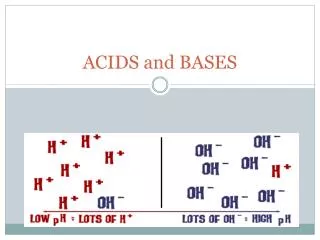
The Nature of the Hydrogen Ion Has No Electron when it is ionized (H+) So it looks for something to bind to for stability In water it attaches itself to the water molecule and forms an H3O+ ion (hydronium) Creates an ion complex with acid like properties This is why you can indicate the presence of an acid with either the H+ ion or the H3O+ ion
Nature of the Hydroxide Ion OH- is what makes many bases basic Given off when a basic compound is placed into water The more OH- (hydroxide ions) that you release in water, the stronger you are in terms of base strength (higher pH 10-14) If H+ ions are present, OH- ions will bind with it to form water (basis of neutralization)