Download
1 / 10
110 likes | 231 Vues
This study explores Lambert Libris, a book series designed for bilingual Deaf children, utilizing RFID technology to improve emergent literacy. Developed through a grant from NCTI, the project incorporates American Sign Language (ASL) videos and interactive assessments, fostering engagement and comprehension. With colorful stories focusing on "colors," the initiative bridges the gap between ASL and printed English, encouraging literacy growth and enhancing the learning experience in Deaf classrooms. Results from the pilot program reveal positive student engagement and potential for further research.

E N D
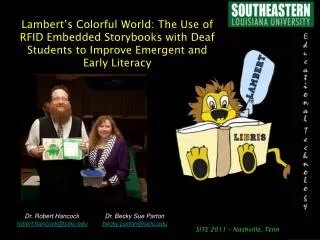
Lambert’s Colorful World: The Use of RFID Embedded Storybooks with Deaf Students to Improve Emergent and Early Literacy Shari Shari Dr. Robert Hancock robert.hancock@selu.edu Dr. Becky Sue Parton becky.parton@selu.edu SITE 2011 – Nashville, Tenn
LAMBERT LIBRIS A book series for bilingual Deaf children Funded by a grant from NCTI http://www.lifted-up.org/ Shari Shari The Louisiana Initiative for Technology Exploration with the Deaf “Storybook sharing can serve as a bridge between the language of delivery (American Sign Language) and the language of printed material (English) for Deaf children.” SITE 2011 – Nashville, Tenn
Development Summary • Team decided on “colors” for the story topic. • Dr. Hancock created all the book illustrations. • The book was published. • RFID (Radio Frequency Identification) tags were put on each page. • Adhesive back tags were used. • Tags were placed in alt page corners. • Tags were covered with a sticker. • Native Deaf signers created the ASL videos. • We mixed the images and ASL into exe files. • We authored software to respond to the tags. • Burton Vision created a companion assessment tool. • Twenty comprehension questions were identified. • The quiz was displayed in both ASL and English. • A progress tracking component was included for teachers. SITE 2011 – Nashville, Tenn
Sample Book Pages The entire storybook is available on our website. SITE 2011 – Nashville, Tenn
Sample Screenshot of Video All of the ASL videos are available on our website. SITE 2011 – Nashville, Tenn
Sample Screenshot of the Assessment The quiz was also signed by native, Deaf adults.Mike Burton, founder of Burton Vision, created a custom module for the project. SITE 2011 – Nashville, Tenn
Prototype Testing Each classroom was given a laptop computer, an RFID reader, a book, and the software. Teachers could choose how to introduce and use the storybook – most chose “centers” only. Students were also asked to take the assessment at the end of the study. SITE 2011 – Nashville, Tenn
Photos! On our website, you can see a video of the students using Lambert Libris. SITE 2011 – Nashville, Tenn
Findings & Discussion • The children were excited to use the system and it appeared to keep them engaged in the story. • The children had no difficulty operating the equipment. • None of the teachers allowed the system to be taken home but that needs to be an area of research – i.e. does the system facilitate the parent/child bond. • The teachers liked the assessment system conceptually, but thought the comprehension questions were too difficult. • The goal of Lambert Libris is to improve literacy long-term but that was not addressed in this initial study. • We hypothesize that greater gains in literacy will occur among students who otherwise would not be exposed to native signers. SITE 2011 – Nashville, Tenn
News We were honored to be a 2010 Bright Idea Award Winner at the national competition in Washington DC in November 2010! SITE 2011 – Nashville, Tenn