Overview of Haemophilus and Fastidious Gram-Negative Bacilli Infections
680 likes | 831 Vues
This text explores the diverse group of fastidious gram-negative bacilli, focusing on Haemophilus species, particularly Haemophilus influenzae. It discusses their requirements for growth factors (X and V), clinical manifestations including acute epiglottitis, meningitis, and pneumonia, as well as associated epidemiology and pathogenesis. The importance of laboratory diagnosis through culture and biochemical identification is emphasized, alongside treatment options and the impact of vaccination. Risk factors for invasive disease and antibiotic resistance patterns are also reviewed.


Overview of Haemophilus and Fastidious Gram-Negative Bacilli Infections
E N D
Presentation Transcript
Haemophilus and Other Fastidious GNB • The fastidious group of gram-negative bacilli: • Haemophilus • HACEK( Haemophilus, Actinobacillus, Cardiobacteria, Eikenella & Kingella) • Legionella • Bordetella • Pasteurella • Brucella • Francisella • Bartonella
Haemophilus Species • Haemophilus = “blood loving” • Require either heme (X factor) or NAD (V factor) • Small pleomorphic GNB, oxidase positive
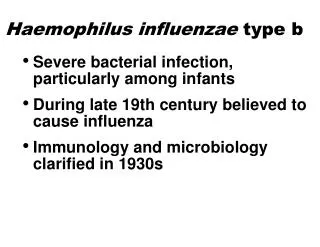
Haemophilusinfluenzae • Polysaccharide capsule • Six different serotypes (a-f) of polysaccharide capsule • 95% of invasive disease caused by type b (Hib) • Non-capsulated strains: non pathogenic (normal flora of respiratory tract)
Clinical Infections: • Acute epiglottitis/ laryngotracheal infection in small children • Can cause airway obstruction needing immediate tracheostomy • Cellulitis/arthritis: cheek and upper extremities • Meningitis :Children under 6 years • Contagious, vaccine has decreased incidence • Pneumonia/septicemia : In children • Conjunctivitis “pink eye” very contagious
Clinical Infections: nontypable strains • Otitis media • Children 6 months- 2 years • Sinusitis • Pneumonia, bronchitis • In adults • These sites are all in proximity to respiratory tract
Haemophilus influenzae type b Clinical Manifestations* *prevaccination era
Haemophilusinfluenzae type b Epidemiology • Reservoir Human Asymptomatic carriers • Transmission Respiratory droplets • Temporal pattern Peaks in Sept-Dec and March-May • Communicability Generally limited but higher in some circumstances
Risk factors for invasive disease • Exposure factors • household crowding • day care attendance • low socioeconomic status • In schools, hostels
pathogenesis…………………….. • Penetrate nasopharynx • and invades blood stream • Causes meningitis, pneumonia, bacteremia • 95% of invasive disease caused by type b
HaemophilusInfluenzae: Virulence Factors • Capsule: Antiphagocytic • IgA Protease: Cleaves IgA on mucosal surfaces • Lipid A: Effects ciliated respiratory epithelium • Pili: Attachment
Sample collection: • CSF, blood, sputum. Diagnosis is confirmed when the organism is isolated from a sterile body site (Blood & CSF) • Sample should never be refrigerated • Gram Stain: Usually very small pleomorphic gram negative coccobacilli
Direct smear of H. influenzae in CSF in a case of meningitis. Note the TINY intracellular and extracellular pleomorphic gram-negative bacilli. Remember to look for capsules surrounding the rod.
Capsule detection: Quellung reaction (capsular swelling) when CSF is mixed with type b antiserum. • Methylene blue is added • Observed under microscope
Antigen detection: type b capsular antigen detected in CSF, by LATEX AGGLUTINATION TEST
CULTURE • On Chocolate Agar: semi-opaque, gray-white, convex, mucoid. (5-10% CO2)
Growth factors • Haemophilus species require growth factors: • X-factor ( hemin) • Heat-stable substance • Present in RBC and released with degradation of hemoglobin • V-factor (NAD): Nicotinamide adenine dinucleotide) • Heat- labile • Found in blood or secreted by certain organisms
Fildes agar: • Levinthals agar:
BIOCHEMICAL IDENTIFICATION: • Catalase + • Oxidase + • X and v factor strips or disks • Reduces nitrate to nitrite • Ferments glucose & xylose • BIOTYPING: (indole, ornithine & urease) • SEROTYPING: (antisera)
Vaccine: • PRP capsular Ag of Hib is used as vaccine candidate • Conjugated to adjuvants: toxoids, OMP Chemoprophylaxis: • Oral rifampin ( household contacts & HCW) Treatment: • Cefotaxime, ceftriaxone, azithromycin levofloxacin
Haemophilusducreyi • Causative agent of chancroid or soft chancre (STD), highly contagious, painful • Specimens should be collected from base of lesion, inoculated directly to enriched media and held for 5 days • Gram stain appears as groups of coccbacilli that resemble a ‘school of fish” or “railroad tracks” • Requires only X factor to grow
Haemophilus Species Identification V=variable
ANTIBIOTIC THERAPY • Historically ampicillin was drug of choice. • However, resistance has developed due to production of beta-lactamase or altered penicillin binding proteins and cell wall permeability • Primary antibiotics include cefotaxime or ceftriaxone
HACEK Group • HACEK is an acronym of the first initial of each genus that belong in the group: • Haemophilusaphrophilus: • NAME ALERT: Now called Aggregatibacteraphrophilus • Not a true Haemophilus because does not need X nor V • Actinobacillusactinomycetemcomitans • Cardiobacteriumhominis • Eikenellacorrodens • Kingella species • Habitat • Commensals of oral cavity • Clinical Significance • Infective endocarditis • Peridontal disease • Dental caries • Infections following dental procedures
HACEK Group: General Characteristics • Gram-negative bacilli • Require an increased CO2 (5%-10%) environment • Slow/poor growers • Usual flora of the oralpharyngeal cavity • Opportunists in immunocompromised hosts
Capnocytophaga sp. • Capnophilic • Facultative anaerobe • Part of the normal oralpharygeal flora • Cause periodontal disease, sepsis
Pasteurella species • General characteristics • Colonizes mucous membranes of the upper respiratory tract and gastrointestinal tracts of mammals and birds • Human infections occur from bites and scratches inflicted by animals, primarily felines • Results in a localized, pus- producing infection • Can cause life-threatening systemic disease • Most common isolated species is Pasteurella multocida
Pasteurella multocida • Culture characteristics • Growth on 5% blood or chocolate shows small, smooth, grayish,convex colonies • Non-hemolytic • “Musty” or earthy odor • No growth on MacConkey agar
Pasteurella multocida • Microscopic examination • Very small gram-negative rods • Bipolar staining with Giemsa or methylene blue • “Safety-pin” appearance
Pasteurella multocida: Identification • Oxidase positive • Indole positive • Nonmotile • Catalase positive • Glucose fermenter
Brucella species • Causes infection in cattle (zoonosis) • Acquired through aerosol, percutaneous and oral routes of exposure • Brucellosis • Primarily seen with animal handlers and those who handle animal products • Also known as Malta or undulant fever • Type 3 biohazard – can be transmitted through unbroken skin • Category B Biological agent- easy to disseminate and cause moderate morbidity, but low mortality.
Brucella species: Identification • Colony Morphology • Small, smooth, convex, nonhemolytic • May require holding culture for 21 days • Gram Stain Morphology • Small gram-negative coccobaccilli • Nonmotile • Aerobic • Oxidase positive • Catalase positive • Urease positive
Francisella tularensis • Highly infectious Type 3 biohazard – can be transmitted through unbroken skin, bite from an insect, direct contact with infected animals or inhalation of aerosols • Category A Biological agent-it can be spread from person to person or disseminated, high mortality rates • Infection in rabbits, sheep, squirrels and ticks • Zoonotic infection in humans • Tularemia
Francisella tularensis: Identification • Colony Morphology • BAP = No growth • MAC = No growth • Choc = Small, smooth, gray gncb at 2-5 days • Requires special media (BCYE or MTM) • Oxidase: negative • Catalase: negative- weak positive • Ferments glucose • X and V negative • NOTE: Usually identified by DFA or direct agglutination tests due to risk of lab acquired infection