Understanding Elements, Compounds, and Mixtures in Matter
Explore the fundamental differences between elements, compounds, and mixtures, key concepts in chemistry. Discover what defines an element as a pure substance, how compounds form through chemical reactions, and the characteristics of mixtures that are not chemically combined. Learn about the various types of elements—metals, non-metals, and metalloids—along with the properties that distinguish compounds from mixtures. This study guide simplifies complex concepts into clear explanations, enhancing your understanding of the structure and organization of matter.

Understanding Elements, Compounds, and Mixtures in Matter
E N D
Presentation Transcript
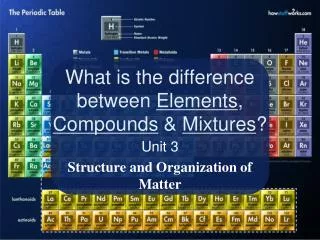
What is the difference between Elements, Compounds & Mixtures? Unit 3 Structure and Organization of Matter
What ISN’T an Element? • Earth, wind, fire and water are NOT elements! • Earth - most all substances on the periodic table • Wind - air is made up of multiple gases • Fire - is plasma, anything burning • Water - Hydrogen & Oxygen
What ARE Elements? • Pure substances • Any substance with a single kind of particle • Those particles ALL have the same kind of atoms • The particles cannot be divided further. Diamond = pure carbon
How are Elements Identified? • Physical Properties • Boiling point • Melting point • Density • Chemical Properties • Reactivity with acid • Reactivity with oxygen
How are Elements Categorized? • By their properties • Physical & Chemical • Three major types of elements • Metals • Metalloids • Non-metals
What are Metals? • Shiny, good conductors of heat & electricity • Malleable - can bend • Ductile - pulled into wire • 95% of all elements are metals
What are Non-metals? • Dull, not too shiny • Poor conductors of heat & electricity • Solids are brittle and break easily • Not many solid objects are made up of non-metals
What are Metalloids? • They are semi-conductors • Some conduct electricity • Electrical conductivity is not as good as metals • Have some properties of both metals & nonmetals • Shiny, metallic appearance • Some are malleable & ductile
What are Compounds? A pure substance made of 2 or more elements.
What else can be said of Compounds? • Elements combine through a chemical reaction • Elements don’t randomly form compounds • Elements combine in a very specific ratio - based on the element’s mass
What are the properties of Compounds? • Physical properties are similar to Elements: • Melting point, density, etc… • Chemical properties can include: • Reactivity to oxygen • Reactivity to acid • Reactivity to light Caffeine
Can Compounds be broken down? • Through a chemical change • Most time a lot of energy must be added to cause the change • Heat • Electricity • Light Light can break this compound down
What are common Compounds? • Common organic compounds include carbon, nitrogen, hydrogen and oxygen • Such as those found in caffeine • Theobromine - the active ingredient in chocolate
What is a Mixture? A combination of 2 or more substances that are NOT chemically combined
What is a Mixture? (continued) • Two or more substances will not react together • No chemical change occurs • Each substance has the same chemical makeup in the mixture • Salt water • The salt (NaCl) is still there as well as the water (H2O)
Can Mixtures be separated? • Yes, through…. • Distillation • Uses boiling points • Evaporation • Atmospheric pressure • Magnet • Removing iron • Centrifuge • Uses the densities
Made of elements, compounds, or both No charge in original properties of components - not electrical Separated by physical means Formed using ANY ratio of components Made of elements only Change in original properties of components Separated by chemical means Formed using a set ratio of components Mixtures vs. Compounds
What about the ratio of components in a Mixture? • Do not have to be mixed in any particular ratio • Granite is an excellent example of this quality to mixtures
What is a solution? • A mixture that appears to be a single substance • Composed of 2 or more substances that are distributed evenly among each other • Have the same appearance & properties throughout • Cannot be filtered
What are parts to a solution? • The process of particles separating spreading through a mixture is called dissolving • Solute - the substance that is dissolved • Solvent - the substance in which thesolute isdissolved
What are examples of different Solutions? • Gas in gas - • dry air, O2 In N2 • Gas in liquid - • soft drinks, CO2 in H2O • Liquid in liquid - • antifreeze, alcohol in H2O • Solid in liquid - • Salt water, NaCl in H2O • Solid in solid (Alloy)- • brass, zinc in copper
What is Solubility? • The ability of a solute to dissolve in a solvent, like… • Putting sugar in water • Only so much sugar (solute) will dissolve in water (solvent)
What is the difference between Dilute & Concentrated • Dilute solution contains less solute • Concentrated solutions contain more solute
Dissolving gases in Liquids • As the solvent (water) becomes warmer the gas becomes less soluble • This is why a warm can of Mountain Dew will go “flat” faster. • Gas that is dissolved in the water can’t stay dissolved as the temperature rises.
Dissolving Solids in Liquids • Three ways to speed up the dissolving • Mixing/stirring (agitating) the solute in the solvent • Heating the solvent • Crushing the solute before placing it in the solvent 2 3 1
What is a Suspension? • A mixture in which the particles are dispersed throughout but are large enough to settle out • Heterogeneous • Must be shaken or stirred periodically to remain mixed • The suspension can be separated by use of a filter
What are Colloids? • Mixtures with properties in between solutions & suspensions • Homogeneous • Particles are dispersed throughout but are not heavy enough to settle out
Element, Compound, or Mixture?
Next up ….. The Periodic Table of the Elements!