Download
1 / 24
250 likes | 406 Vues
This lecture focuses on the evolutionary trends and classification of angiosperms, primarily examining the distinctions between dicots and monocots. It highlights the characteristics of various families including woody plants and herbs, as well as the importance of structural features such as flowers, fruits, and root systems. The classification within the divisions of Magnoliophyta is explored, emphasizing the diversity and evolutionary significance of these plant groups. Various families of dicots and monocots are outlined, showcasing the complexity and richness of angiosperm flora.

E N D
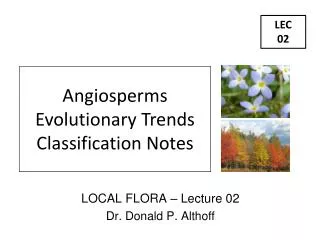
LEC 02 Angiosperms Evolutionary Trends Classification Notes LOCAL FLORA – Lecture 02 Dr. Donald P. Althoff
Woody plants usually _________ the herbs, vines, and climbers ______________ gave rise to biennials…and annuals have derived from both perennials & biennials Dicots are considered ______primitive than monocots Evolutionary Trends in Angiosperms (in general)
DICOTS gymnosperms Flowers Seed-bearing
Alternate leaves with secretory cells are ____________ compared to opposite or whorled leaves without secretory cells. Many separate stamens are more _________ than few or united stamens Single fruits _________ aggregate fruits formed from several ovaries OVERALL: _________ are not necessarily primitive, but have become _______ as a result of reduction from complex parts. Evolutionary Trends in Angiosperms (in general)…con’t
_______ Fruits __________ Fruits
_______ Stamens _____ Stamens Fuschia St. Johnswort
Dicotyledons (dicots): _______________ Monocotyledons (monocots) __________ Within the Division of Magnoliophyta ( = Anthophyta) Two Classes*
______ diverse About _____ of species are ________ Cotyledons: __ (rarely 1, 3, or 4) Leaves: usually __________ Primary vascular bundle: ________ Floral parts (except carpels)sets of _________ Root system: __________________ _______…in general (vs. monocots)
1 vs. 2 cotyledons Abundance of ______________ roots
_____ diverse Less than ____ of species are _______ Cotyledons: ___ Leaves: usually _________-veined Primary vascular bundle: ________ or in 2 or more ______ Floral parts (except carpels) sets of _________ Root system: adventitious (characteristic of ferns, too) Probably evolved from ___________ of dicots early in the evolutionary history of angiosperms _________…in general (vs. dicots)
Some… Woody(tree/shrub/vine)Families • Aceraceae • Anacardiaceae • Annonaceae • Betulaceae • Caprifoliaceae • Cornaceae • Ericaceae • Fagaceae • Grossulariaceae • Hippocastanaceae • Juglandaceae • Magnoliaceae • Moraceae • Oleaceae • Salicaceae • Smilacaceae • Ulmaceae
Some… Forb/Herb Families • Guttiferae (Clusiaceae) • Lamiaceae • Liliaceae • Lythraceae • Malvaceae • Nymphaeaceae • Orchidaceae • Oxalidaceae • Phytolaccaceae • Polygonaceae • Portulacaceae • Ranunculaceae • Scrophulariaceae • Alismataceae • Apiaceae • Apocynaceae • Araceae • Asclepiadaceae • Asteraceae • Balsaminaceae • Brassicaceae • Campanulaceae • Caryophyllaceae • Convolvulaceae • Fabaceae*** • Geraniaceae
DICOT DICOT “Combo” Families: woody & herb • Fabaceae [alternate name:Leguminosae] “legumes family” alfalfa birdfoottreefoil partridge pea round-headed lespedeza s. partridge pea slimflowerscurfpea white clover yellow sweet clover wild blue indigo black locust* • Rosaceae • “rose family” rough avens* white avens* Am. plum black cherry black chokeberry black raspberry blackberry prairie rose multi-flora rose sweet (American) crap apple
Plantae Kingdom Division Class Subclass Order Family Genus Magnoliophyta(Anthrophyta) 1 Magnoliopsida-dicots 2 Liliopsida-moncots -6 -5 1 2
Dicotyledons(Division Magnoliophyta, Class Magnoliopsida) 1 Characteristics Subclasses (6) • Advancement • Carpels • Flowers • Stamens • Pollen • Magnoliidae(8o.39f.11,000s) • Hamamelidae(11o.24f.3,400s) • Caryophyllidae(3o.14f.11,000s) • Dilleniidae(13o.78f.25,000s) • Rosidae(18o.114f.58,000s) • Asteridae(11o.49f.56,000s) Cronquist system 1981
Monocotyledons (Division Magnoliophyta, Class Magnoliopsida) 2 Characteristics Subclasses (5) • Alismatidae(4o.16f,500s) • Arecidae(4o.5f.5,600s) • Commelinidae(6o.16f,16,200s) • Zingiberidae(2o.9f.3,800s) • Liliidae(2o.19f,25,000s) • Advancement • Carpels • Flowers • Stomatal Subsidiary Cells
Characteristics helpful in “subclass” classification • ________________: 1 or more features vs. relatively primitive • Carpels: apocarpous vs. syncarpous • Flowers: primitive to well developed • Pollen: monosulcate vs. tricolpate (for dicots) • Stomatal subsidiary cells: 04 (for monocots)
APOCARPOUS Carpels_________ in single individual pistils SYNCARPOUS _______ Carpels resulting in compound ovary • CARPELS = megasporophyll
_________________ globosesymmetrical, usually ___germinal apertures ___________________ boat-shaped, 1 long germinal furrow, ___germinal aperture • POLLEN oak grass Lilium onion Artemisia
Summary thoughts on classification…for now • ______ characteristics to examine • Some characteristics are very “definitive”…others require some “_______________” (ex. primitive vs. slightlyadvanced) • _______________into a subclass, order, family, and even genus is subject to revision