Understanding Our Solar System: True or False Quiz
Test your knowledge of the solar system with this engaging True or False quiz. Explore essential facts about the sun, planets, and comets, and discover how gravity and inertia keep planets in their orbits. Find out if the sun is larger than Earth, what the inner and outer planets have in common, and what comets are made of. Perfect for students and astronomy enthusiasts, this review will reinforce your understanding of these fundamental concepts within our solar system.

Understanding Our Solar System: True or False Quiz
E N D
Presentation Transcript
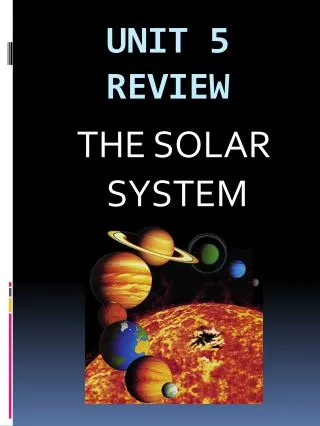
UNIT 5 REVIEW THE SOLAR SYSTEM
True or FalseThe sun is a star that is at the center of our solar system. • True • False
True or FalseThe sun is a star that is at the center of our solar system. • True • False
What is the source of most energy on Earth? • Jupiter • The moon • Wind • The sun
What is the source of most energy on Earth? • Jupiter • The moon • Wind • The sun
The sun is one of _______ of stars in the universe. • hundreds • thousands • millions • billions
The sun is one of _______ of stars in the universe. • hundreds • thousands • millions • billions
The hottest stars are ______ and the coolest stars are ______. • red; blue • yellow; green • blue; red • yellow; blue
The hottest stars are blue and the coolest stars are red. • red; blue • yellow; green • blue;red • yellow; blue
True or FalseThe sun is not the larger than the Earth. • True • False
True or FalseThe sun is not the larger than the Earth. • True • False – the sun is larger than everything else in the solar system
True or FalseThe sun has a medium temperature. • True • False
True or FalseThe sun has a medium temperature. • True • False
The center of the sun is called the ______. • middle • atmosphere • core • hot spot
The center of the sun is called the ______. • middle • atmosphere • core • hot spot
The surface of the sun is known as the ______. • photosphere • atmosphere • core • outer part
The surface of the sun is known as the ______. • photosphere • atmosphere • core • outer part
True or FalseThe sun’s energy is produced under enormous pressure. Hydrogen atoms smash into each other and produce helium. • True • False
True or FalseThe sun’s energy is produced under enormous pressure. Hydrogen atoms smash into each other and produce helium. • True • False
What are the four inner planets? • Earth, Jupiter, Saturn, & Pluto • Mercury, Venus, Mars, & Jupiter • Mercury, Earth, Neptune, & Jupiter • Mercury, Venus, Earth & Mars
What are the four inner planets? • Earth, Jupiter, Saturn, & Pluto • Mercury, Venus, Mars, & Jupiter • Mercury, Earth, Neptune, & Jupiter • Mercury, Venus, Earth & Mars
True or FalseVenus, Earth, and Mars are the three planets that can support life. • True • False
True or FalseVenus, Earth, and Mars are the three planets that can support life. • True • False – Earth is the only planet that can support life.
What do all of the inner planets have in common? • They are rocky. • They all support life. • They have nothing in common. • None of the above.
What do all of the inner planets have in common? • They are rocky. • They all support life. • They have nothing in common. • None of the above.
Why are the outer planets called gas giants? • They produce gas for the solar system. • They are large and made up mostly of the gases hydrogen and helium. • They are large and made up mostly of oxygen.
Why are the outer planets called gas giants? • They produce gas for the solar system. • They are large and made up mostly of the gases hydrogen and helium. • They are large and made up mostly of oxygen.
Which is the largest planet in our solar system? • Earth • Neptune • Jupiter • Saturn
Which is the largest planet in our solar system? • Earth • Neptune • Jupiter • Saturn
What are comets made of? • Ice, sand, & minerals • Ice, boulders, & salt • Ice, rock , & frozen gases • Water, lint, & dust particles
What are comets made of? • Ice, sand, & minerals • Ice, boulders, & salt • Ice, rock , & frozen gases • Water, lint, & dust particles
True or FalseThe Earth and the other planets revolve around the sun in a circular orbit. • True • False
True or FalseThe Earth and the other planets revolve around the sun in a circular orbit. • True • False – The planets revolve around the sun in an elliptical orbit.
What two properties explain why the planets stay in their own orbit and don’t crash into each other? • Inertia & gravity • Inertia & light • Gravity & rotation • Magic & pixie dust
What two properties explain why the planets stay in their own orbit and don’t crash into each other? • Inertia & gravity • Inertia & light • Gravity & rotation • Magic & pixie dust
True or FalseThe same side of the moon always faces Earth. • True • False
True or FalseThe same side of the moon always faces Earth. • True • False
How much of the moon we see depends on its _________. • light • speed • shape • phase
How much of the moon we see depends on its _________. • light • speed • shape • phase