Exploring the FATINT System: Evolutionary Technology and Phenotype Plasticity
10 likes | 125 Vues
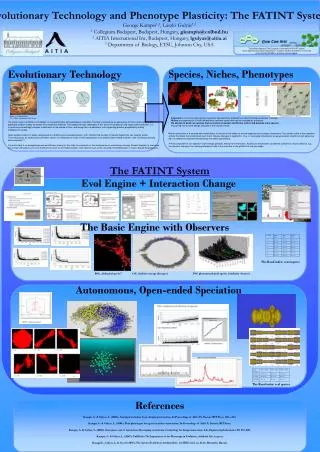
This paper investigates the FATINT system, which focuses on evolutionary technology and phenotype plasticity. It addresses the challenges of open-ended evolution, the emergence of complexity, and the role of species and niches in shaping ecological interactions. By examining evolutionary methods and interactions between organisms and their environments, the authors propose a model for producing diverse and complex artifacts through sustained evolution. This research highlights the potential for constructing new species that adaptively fill ecological niches, enhancing our understanding of evolutionary dynamics.


Exploring the FATINT System: Evolutionary Technology and Phenotype Plasticity
E N D
Presentation Transcript
Evolutionary Technology and Phenotype Plasticity: The FATINT System George Kampis1,3, László Gulyás1,2 1 Collegium Budapest, Budapest, Hungary, gkampis@colbud.hu 2 AITIA International Inc, Budapest, Hungary, lgulyas@aitia.ai 3 Department of Biology, ETSU, Johnson City, USA The partial support of The European Commission’s FP6 IST project Quasi-Opportunistic Supercomputing for Complex System Simulations on the Grid (QosCosGrid) #033883 is gratefully acknowledged. Evolutionary Technology The direct route to artifacts is via design, i.e. by specification and subsequent realization.The task is to produce an abundance of forms and functions of a practically endless variety by means of evolutionary methods. This implies the twin challenges of the ’arrow of complexity’ and ’open-ended evolution’, i.e. of producing increasingly complex machineries in the course of time, and doing that in a persistent, self-supporting process propelled by entirely endogenous causes. Open-ended evolution is widely recognized as a difficult and unsolved problem. John Holland, the founder of Genetic Algorithms has recently asked: ”Can we produce an existence-proof model, akin to von Neumann’s model of self-reproduction, that exhibits open-ended evolution, with increasing diversity and complexity? ”. Currently there is no accepted general evolutionary theory for the origin of complexity or the maintenance of evolutionary change. Recent attempts to overcome one or both difficulties come from Artificial Life (such as the AVIDA system) and robotics such as the renowned GOLEM project or swarm-based developments. Species, Niches, Phenotypes A species is a set of co-reproducing organisms reproductivelyisolated from others (’biological species’ concept). Niches are segments of a (multi-dimensional) resource space that can be occupiedby a species. We attempt to buildnew species that recursively construct and fill new niches and produce more species, thus giving rise to more design solutions in the course of time. Niche construction is a recently advocated theory of evolutionthat builds on mutual organism-environment interactions. The central notion is the organism’ activity that alters the environment such that it induces changes in organisms. E.g., in ’ecological inheritance’ a new generationinherits not just genes but also an altered environmentleft behind by the earlier generations. A third component of our approach is phenotypeplasticity arising from interaction.A particular mechanism considered sufficient is sexualselection, e.g., the dynamic change in the mating preferences (like in the evolution of the giraffe from the pre-okapi). Rama, an O’Neill cylinder A.C. Clarke: Rendezvous with Rama The FATINT System Evol Engine + Interaction Change The Basic Engine with Observers The Rand index: convergence BSC: „biological species” CSC: cladistic concept (lineages) PSC: phenomenological species (similarity clusters) Autonomous, Open-ended Speciation The Rand index: real species References Kampis, G. & Gulyas, L. (2004). Sustained evolution from changing interaction. In Proceedings of ALife IX. Boston: MIT Press, 328—333. Kampis, G. & Gulyas, L. (2006). Phat phenotypes for agents in niche construction. In Proceedings of ALife X. Boston: MIT Press. Kampis, G. & Gulyas, L. (2006). Emergence out of interaction: Developing evolutionary technology for design innovation. Adv. Engineering Informatics 20, 313-320. Kampis, G. & Gulyas, L. (2007). Full Body: The Importance of the Phenotype in Evolution, Artificial Life, in press Kampis,G., Gulyas, L. & Soos,S (2007). The Species Problem in Artificial Life, 1st IEEE Conf. on ALife, Honololu, Hawaii. .