Understanding Employment-Based Immigration: Key Policies and Changes Over Time
This comprehensive overview delves into the evolution of employment-based immigration in the U.S. since the late 19th century, highlighting significant anti-terrorism legislation post-9/11, including the US PATRIOT Act and changes in deportable crimes. It examines the establishment of preference categories for admitting foreign nationals with special skills, the implications of DACA, and the redefined non-immigrant visa categories. Discover the complexities of employment immigration, covering Temporary Work Visas and immigrant visas (Green Cards), and trace the historical context leading up to today’s policies.


Understanding Employment-Based Immigration: Key Policies and Changes Over Time
E N D
Presentation Transcript
Peddibhotla Law Firm39899 Balentine Drive, Suite 118 Newark, CA 94560 (510) 498-1949 www.immi-law.com contact@immi-law.com Immigration Panel
Anti-terrorism legislation introduced; Expanded deportable crimes; introduced 3 & 10 year bars Immigration Timeline Post 9/11 enhanced security and anti-terrorism measures (US PATRIOT Act). DHS is born Preference category system for admitting foreign nationals with special skills. Amnesty program Exclusionary policies; notably Chines Exclusion Act of 1882 (1875-1917) H-4 Work Authorization proposed 2000 1990 1917 1776 1875 1965 1986 1996 2001 2011 2014 1952 Watershed moment for Asian Immigration Open Door Policy 1st 100 Years Deferred Action & DACA H-1B Cap temporarily increased to 195K for FY 2001-2003 (AC21) Per Country quota system (1917-1951) US eliminated racial and national origin quotas, but established Western and Eastern hemisphere quotas. Employment based preference categories established. Non-immigrant visa categories of H-1B, H-3, E, and L-1 redefined
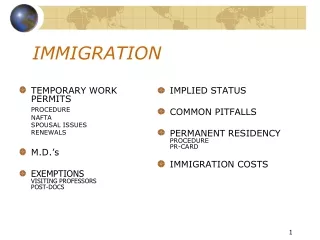
What is Employment-based Immigration Status? • When an individual enters the U.S. on an employment-based status, this means the individual’s immigration status is tied to his/her employment. • The specific type of status may govern where, when, and the nature of work the individual may engage in while in the U.S. In most cases, the individual is only permitted to work for one particular employer. • Employment immigration is divided into: (1) Temporary Work Visas; and (2) Immigrant Visas (Green Card)
Temporary Work Visas Common Types of Employment-Based Nonimmigrant Visa Categories
Immigrant Visas (“Green Card”) Common Types of Employment-Based Immigrant Visa Categories