Calculating Area Between Curves and the X-Axis Using Definite Integrals
This guide explains how to calculate the area between the x-axis and a continuous function ( f(x) ) over an interval ([a,b]) using definite integrals. The area above the x-axis is treated as positive, while the area below is negative. The process involves setting up integrals for regions bounded by curves ( y = f(x) ) and ( y = g(x) ). We also cover finding area between two curves, determining bounds, and using horizontal and vertical cuts. Examples are provided for integration and area calculation with graphical support.

Calculating Area Between Curves and the X-Axis Using Definite Integrals
E N D
Presentation Transcript
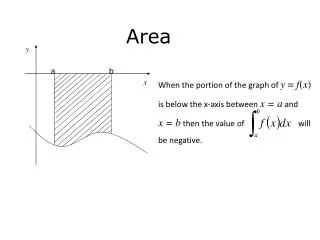
Back to Area: • We can calculate the area between the x-axis and a continuous function f on the interval [a,b] using the definite integral: • Where f(xi*) is the height of a rectangle and ∆x is the width of that rectangle. {(b-a)/n (n is the number of rectangles)} • Remember that the area above the axis is positive and the area below is negative.
Set up the integral needed to find the area of the region bounded by: and the x-axis.
Set up the integral needed to find the area of the region bounded by: , the x-axis on [0,2].
Area bounded by two curves • Suppose you have 2 curves, y = f(x) and y = g(x) Area under g is: Area under f is:
Superimposing the graphs, we look at the area bounded by the two functions: (top - bottom)*∆x
Find the area of the region between the two functions: and Bounds? [-1,2] Top Function? Bottom Function? Area? = 9
Find the area bounded by the curves: and Solve for bounds:
Find the area bounded by the curves: and Sketch the graph: (top - bottom)*∆x
Find the area of the region determined by the curves: and Bounds? In terms of y: [-2,4] Points (-1,-2) & (5,4) Graph? Solve for y:
Find the area of the region determined by the curves: and Need 2 Integrals! One from -3 to -1 and the other from -1 to 5. Area?
Horizontal Cut instead: Bounds? In terms of y: [-2,4] Right Function? Left Function? Area? = 18
In General: Vertical Cut: Horizontal Cut:
Find the Area of the Region bounded by and Bounds? [0,1] Top Function? Bottom Function? Area?
Find the Area of the Region bounded by , , and the y-axis Bounds? [0,π/4] and [π/4, π/2] [0,π/4] Top Function? Bottom Function? Area?
Find the Area of the Region bounded by , , and the y-axis Bounds? [0,π/4] and [π/4, π/2] Top Function? Bottom Function? Area?
Find the area of the Region bounded by Bounds? Interval is from -2, 5 Functions intersect at x = -1 and x = 3 Graph? Top function switches 3 times! This calculation requires 3 integrals!
Find T so the area between y = x2 and y = T is 1/2. Bounds? Top Function? Bottom Function? Area? Taking advantage of Symmetry Area must equal 1/2: Ans: