Understanding the Converse of the Hinge Theorem with Biking Examples
This guide explores the Converse of the Hinge Theorem through practical biking examples. It demonstrates the relationships between triangle sides and angles, helping students grasp how congruent sides influence the lengths of opposite sides. The first example compares two biking groups’ distances from camp using the theorem, while a second example involves a multi-step problem to determine which group is farthest. Engaging diagrams aid understanding, while guided practice reinforces learning by challenging students to apply their knowledge.

Understanding the Converse of the Hinge Theorem with Biking Examples
E N D
Presentation Transcript
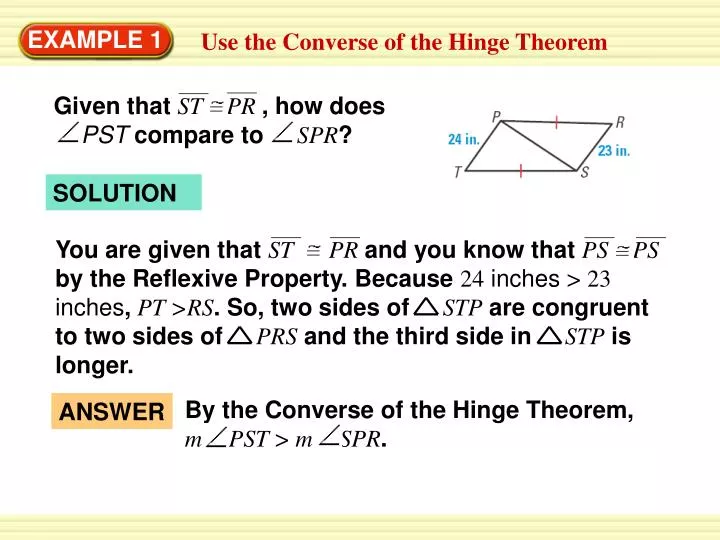
Given that ST PR , how does PSTcompare to SPR? You are given that ST PRand you know that PS PSby the Reflexive Property. Because 24inches>23inches,PT >RS. So, two sides of STPare congruent to two sides of PRSand the third side in STPis longer. ANSWER By the Converse of the Hinge Theorem, mPST>mSPR. EXAMPLE 1 Use the Converse of the Hinge Theorem SOLUTION
BIKING Two groups of bikers leave the same camp heading in opposite directions. Each group goes 2 miles, then changes direction and goes 1.2 miles. Group A starts due east and then turns 45 toward north as shown. Group B starts due west and then turns 30 toward south. o o EXAMPLE 2 Solve a multi-step problem Which group is farther from camp? Explain your reasoning.
o o Because 150 > 135 , Group B is farther from camp by the Hinge Theorem. ANSWER EXAMPLE 2 Solve a multi-step problem SOLUTION Draw a diagram and mark the given measures. The distances biked and the distances back to camp form two triangles, with congruent 2 mile sides and congruent 1.2mile sides. Add the third sides of the triangles to your diagram. Next use linear pairs to find and mark the included angles of 150°and 135°.
If PR = PSand mQPR > m QPS, which is longer, SQ or RQ? 1. ANSWER RQ for Examples 1 and 2 GUIDED PRACTICE Use the diagram at the right.
RPQor SPQ? If PR =PSand RQ < SQ, which is larger, 2. ANSWER SPQ for Examples 1 and 2 GUIDED PRACTICE Use the diagram at the right.
WHAT IF? In Example 2, suppose Group C leaves camp and goes 2 miles due north. Then they turn 40°toward east and continue 1.2miles. Comparethe distances from camp for all three groups. for Examples 1 and 2 GUIDED PRACTICE 3. ANSWER Group B is the farthest from camp, followed by Group C, and then Group A which is the closest.