Investigating Bystander Effects in Neural Stem Cells Post-Irradiation Using Media Transfer
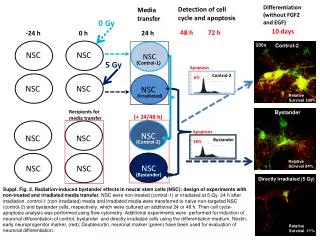
This study explores the radiation-induced bystander effects in neural stem cells (NSCs) through the design of media transfer experiments. NSCs were either non-treated or irradiated at 5 Gy, after which control and irradiated media were transferred to naïve NSCs. Flow cytometry was employed for cell cycle and apoptosis analysis following 24 or 48 hours of culture. Additionally, neuronal differentiation induction was assessed in control, bystander, and directly irradiated cells using differentiation markers, demonstrating varying impacts on cell survival and differentiation.

Investigating Bystander Effects in Neural Stem Cells Post-Irradiation Using Media Transfer
E N D
Presentation Transcript
Differentiation (without FGF2 and EGF) Detection of cell cycle and apoptosis Media transfer Suppl. Fig. 2. Radiation-induced bystander effects in neural stem cells (NSC): design of experiments with non-treated and irradiated media transfer. NSC were non-treated (control-1) or irradiated at 5 Gy. 24 h after irradiation, control-1 (non-irradiated) media and irradiated media were transferred to naive non-targeted NSC (control-2) and bystander cells, respectively, which were cultured an additional 24 or 48 h. Then cell cycle- apoptosis analysis was performed using flow cytometry. Additional experiments were performed for induction of neuronal differentiation of control, bystander and directly irradiated cells using the differentiation medium. Nestin, early neuroprogenitor marker, (red); Doublecortin, neuronal marker (green) have been used for evaluation of neuronal differentiation. 0 Gy 10 days 48 h 72 h 24 h -24 h 0 h 200x Control-2 NSC NSC NSC NSC NSC 5 Gy (Control-1) Apoptosis Control-2 6% NSC NSC NSC (Irradiated) Relative Survival 100% Recipientsfor media transfer Bystander (+ 24/48 h) Apoptosis NSC NSC NSC Bystander (Control-2) 18% Relative Survival 84% NSC NSC NSC (Bystander) Directly irradiated (5 Gy) Relative Survival 11%