Understanding Solar Neutrinos and Neutrino Oscillations: Insights from Experiments
This presentation explores the intriguing phenomena of solar neutrinos and the concept of neutrino oscillations. It discusses the Standard Solar Model (SSM), detailing the nuclear reactions occurring in the Sun, such as the p-p chain and CNO cycle. The talk highlights key solar neutrino experiments, including Homestake, SAGE, GALLEX/GNO, and SNO, which have revealed discrepancies between predicted and observed neutrino fluxes—addressing the Solar Neutrino Problem. It concludes with the implications of neutrino mass and oscillation theories on our understanding of particle physics.

Understanding Solar Neutrinos and Neutrino Oscillations: Insights from Experiments
E N D
Presentation Transcript
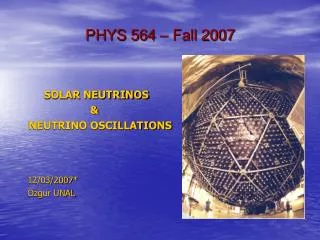
PHYS 564 – Fall 2007 SOLAR NEUTRINOS & NEUTRINO OSCILLATIONS 12/03/2007* Ozgur UNAL
Solar Neutrinos & Neutrino Oscillations • Standard Solar Model • Neutrino Oscillations • Solar Neutrino Experiments • Homestake • SAGE • GALLEX/GNO • SNO
Standard Solar Model (SSM) SSM: • The best physical model of the Sun • Describes the nuclear reactions taking place in the Sun (p-p chain and CNO cycle) • Most of the neutrinos come from p-p chain
Standard Solar Model (SSM) SSM: • Neutrino fluxes and energy spectrum can be predicted by SSM • First experiment (Homestake) to detect the solar neutrinos found much less than predicted Solar Neutrino Problem SSM? Neutrino Oscillations?
Neutrino Oscillations • The flavor change of neutrinos suggests that they are not massless • Eigenstates of the weak interaction, , are linear superpositions of mass eigenstates, , where, U is a unitary matrix • For simplicity, consider a two mass eigenstates and two corresponding flavor eigenstates, • Time evolution of an electron neutrino with momentum p is, where E1and E2are the energies of the mass eigenstates,
Neutrino Oscillations • The probability of an electron neutrino remains an electron neutrino after travelling a distance L is, and the probability to observe a muon neutrino is, • The transition probability depends on the mixing angle, θ, mass square difference, Δm2, the energy and the distance traveled for vacuum oscillations • In medium with constant density, neutrinos interact with matter through electroweak interaction: • This interaction changes the mixing angle and the effective mass of the neutrino eigenstates:
Neutrino Oscillations • The transition probability is maximum for a certain energy of the neutrino and the electron density of matter • Resonance condition: • If the density is not constant, the mixing angle and the effective masses and the eigenstates change continuously • Adiabatic conversion: If density is assumed to change very slowly, some approximations can be made • There are three effects for solar neutrinos on their way to Earth: • Adiabatic conversion inside the Sun • Loss of coherence of the neutrino state • Oscillation of the neutrino mass states in the matter of the Earth
Solar Neutrino Experiments Homestake Experiment: • First SN experiment started in the mid 1960s by Ray Davis • Used 615 tons of dry-cleaning fluid, C2Cl4 • The detection of neutrinos was achieved through the reaction, with 0.814 MeV energy threshold • Announced the first results in 1968: One quarter of the predicted amount of SN • Took data between 1970-1995 and found, ФCl = 2.56 ± 0.16 ± 0.16 SNU whereas SSM prediction is, ФCl (SSM) = 8.1 ± 1.3 SNU 1 SNU is equal to captures per target atom per second.
Solar Neutrino Experiments SAGE: • Russian-American Experiment started in 1990 at Baksan Laboratory in Russia • Used 50 tons of liquid gallium metal • Based on the reaction, with 0.233 MeV threshold energy • Data collected between the years 1990 and 2003 yielded, ФGa = 66.9 ± 3.9 ± 3.6 SNU whereas SSM prediction is, ФGa (SSM) = 126 ± 10 SNU
Solar Neutrino Experiments GALLEX: • Another gallium based experiment started in 1991 at LNGS • Used 30 tons of Ga in an aqueous acid solution (GaCl3-HCl) • Obtained the following capture rate between 1991 and 1997, ФGa = 77.5 ± 6.2 ± 4.5 SNU GNO: • Successor of GALLEX • Took data between 1998 and 2003, ФGa = 62.9 ± 5.4 ± 2.5 SNU SAGE/GALLEX/GNO: • An overall analysis yields, ФGa = 68.1 ± 3.75 SNU
Solar Neutrino Experiments Sudbury Neutrino Observatory (SNO): • Located in 2 km underground in Creighton mine in Canada • Used 1,000 tons of heavy water (D2O) in a 12 m diamater acrylic vessel • Consists of 3 phases: • Phase 1: Only D2O • Phase 2: D2O + NaCl (2 tons) • Phase 3: D2O + NCDs
Solar Neutrino Experiments SNO: • Thanks to D2O, three types of interactions take place in the vessel, νe + d → p + p + e- (CC) νx + d → p + n + νx (NC) νx + e- → νx + e- (ES) • CC is only sensitive to electron neutrinos, → ФCC = øe • NC is equally sensitive to all types of neutrinos, → ФNC = øe + øμτ • ES is mainly sensitive to the electron neutrinos, σ(νe) = 6.5*σ(νμτ) → ФES = øe + 0.15*øμτ
Solar Neutrino Experiments SNO Phase 1: SNO Phase 2: Total 8B flux predicted by SSM: (5.69 ± 0.91)*10-6cm-2s-1
Concluding Remarks • SSM seems to be the best solar model • Success of the theory of neutrino oscillations in explaining the Solar Neutrino Problem • Neutrinos are not massless • A global (Radiochemical + SNO + KamLAND experiments) 2-flavor neutrino oscillation analysis has the best fit values:
References • http://www.columbia.edu/~ah297/unesa/sun/sun-chapter4.html • http://www.sno.phy.queensu.ca/ • http://www.physics.purdue.edu/Zope/courses/phys570E/posting/lecture/Files/lec21.ppt • Bellerive, A. “Review of Solar Neutrino Experiments” hep-ex/0312045, 2003 • Bahcall, J. “New Solar Opacities, Abundances, Helioseismology, and Neutrino Fluxes” The Astrophysical Journal, 621:L85-L88, 2005 • Nakamura, K. “Solar Neutrinos Review”, 2005 • Maneira, J. “SNO & Solar Neutrino Results” Nuclear Physics B (Proc. Suppl.), 168 84-89, 2007 • Cleveland, B. T. et al “Measurement of the Solar Electron Neutrino Flux with the Homestake Chlorine Detector” The Astrophysical Journal, 496:505-526, 1998 • Cattadori, C. et al “Results from Radiachemical Experiments with Main Emphasis on the Gallium Ones” Nuclear Physics B (Proc. Suppl.), 143 3-12, 2005 • SNO Collaboration “Electron Energy Spectra, Fluxes, and Day-Night Asymmetries of 8B Solar Neutrinos from the 391-Day Salt Phase SNO Data Set” • Ahmad, Q. R. et al “Direct Evidence for Flavor Transformation from Neutral-Current Interactions in the Sudbury Neutrino Observatory” Physical Review Letters 89, 011301, 2002 • Smirnov, A. “Recent Developments in Neutrino Phenomenology” hep-ph/0702061v1, 2006