Advances in Millimeter Interferometry: Insights from the Nordic Summer School 2009
The 2009 Nordic Summer School focused on current advancements in millimeter (mm) interferometry, a relatively young technique that has made significant strides since the early 1990s with the Plateau de Bure Interferometer (PdBI) and Submillimeter Array (SMA). Key milestones included improvements in design, antenna configurations, and receiver technology, enabling high spectral resolution and enhanced bandwidth. With few mm interferometers primarily in the Northern Hemisphere, this discussion highlighted challenges and aspirations for the future, such as ALMA's evolution and the development of the Northern Extended Millimeter Array (NOEMA).

Advances in Millimeter Interferometry: Insights from the Nordic Summer School 2009
E N D
Presentation Transcript
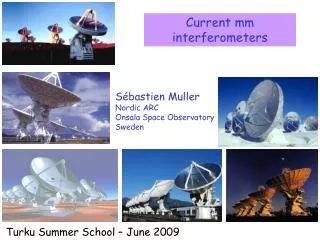
Current mm interferometers Sébastien Muller Nordic ARC Onsala Space Observatory Sweden Turku Summer School – June 2009
Current mm interferometers: few facts - Mm interferometry = Young technique PdBI: early 90s SMA dedication: 2003
PdBI milestones • Design started in 1979 • First antenna completed in 1987 • 3 antennas interferometer observations • opened for guest observers 1990 • First fringes at 230 GHz 1995 • 5 antennas configuration 1996 • 6 antennas configuration 2002 • New generation receivers 2007 • & extension of the tracks • 350 GHz receivers 2009… • Broad-band correlator
Current mm interferometers: few facts - Mm interferometry = Young technique PdBI: early 90s SMA dedication: 2003 - Few mm interferometers, mostly in the Northern hemisphere
Current mm interferometers: few facts - Mm interferometry = Young technique PdBI: early 90s SMA dedication: 2003 - Few mm interferometers, mostly in the Northern hemisphere - Small array Nant < 15 limited instantaneous uv-coverage -> super-synthesis - Limited total collecting area - High altitude site for dry and stable atmosphere
Altitude = 2550m N ant = 6 D = 15m Area = 1060 m2 Altitude = 1340m N ant = 6 D = 10m Area = 471 m2 Altitude = 2200m N ant = 15 D = 6/10m Area = 772 m2 Altitude = 4080m N ant = 8 D = 6m Area = 226 m2 Altitude = 5060m N ant = 50 D = 12m Area = 5652 m2
What did the current generation of mm interferometers achieve ? (Demonstration of the technique) High spectral resolution Polarization capability Bandwidth of up to 4 GHz Angular resolution up to ~0.3 arcsec Detection of molecules up to z=6.42 Open the appetite of (radio-mm) astronomers ! -> ALMA
Let’s take two examples in more details: Plateau de Bure interferometer & SubMillimeter Array
Frequency coverage PdBISMA 80 – 116 GHz 129 – 174 GHz 201 – 267 GHz 186 – 242 GHz 277 – 371 GHz 272 – 349 GHz 320 – 420 GHz (7 ant, high Tsys) 635 – 690 GHz 1 band at a time Dual frequency operations possible (L/H) + 22 GHz water vapor radiometer
FWHM primary beam -> Mosaicing for extended sources
Configurations / Angular resolution SMA @345 GHz Subcompact: 5’’ extended sources Compact: 2.5’’ Compact NS Southern sources Extended: 0.7’’ (Very extended) Bmax = 508 m PbBI @100 GHz D: 5’’ deep integration CD: 3.5’’ mosaicing BC: 1.7’’ HRA mapping B: 1.2’’ AB: 1’’ A: 0.8’’ very compact sources Bmax = 760 m Summer Winter
LSB 2 GHz USB 2 GHz 10 GHz SMA correlator Very flexible: multiple lines with different spectral resolution (up to 25 kHz, on a limited bandwidth)
12CO(2-1) IF x 2 = 10 GHz C18O(2-1) 13CO(2-1) Simultaneous multiple lines / isotopes observations with the SMA NGC 4945 USB Amplitude Phase 2 GHz Amplitude LSB Phase
Q1 Q2 Q3 Q4 HOR pola VER pola Dual pola 4 GHz Simultaneous 2 GHz bandwidth PdBI correlator Dual polarization capability 1 GHz bandwidth/unit (2 units possible at the moment) 8 independent spectral units can be allocated: with 20 to 320 MHz bandwidth with 2.5 MHz to 40 kHz channel spacing A new broadband correlator (WIDEX) will be installed this year
Data reduction / Imaging PdBI GILDAS: CLIC -> MAPPING SMA MIR/IDL -> AIPS, MIRIAD, GILDAS
Tools for proposal preparation - GILDAS/ASTRO - IRAM webpages http://www.iram.fr - SMA Observer Center http://sma1.sma.hawaii.edu -> Tools Beam/sensitivity calculator Calibrator list Passband visualizer
Proposals to PdBI Increasing pressure on observing time Courtesy R. Neri
How to improve the sensitivity ? Example values given for PdBI Courtesy R. Neri
ALMA/ESO Near future Early Science in 2011 More tomorrow
Future of mm interferometry ? Improve the sensitivity: - Large array - Better receivers - Broad bandwidth (continuum sensitivity, line survey) Improve the quality: - Real time phase monitoring (~adaptive optic) Limited fov: - On-the-fly mapping - Multi-beam (pixel) detectors Longer baselines Mm VLBI … another challenge
NOEMA/IRAM Evolution of PdBI -> NOEMA Northern Extended Millimeter Array - Double the number of antennas: 6 -> 12 - Broad bandwidth -> 32 GHz - Extend baselines: 0.8 -> 1.6 km And possible further evolution (better receivers, multi-beam …)