Understanding Heteronyms, Autoantonyms, and Antiautonyms in English
110 likes | 242 Vues
Dive into the fascinating world of heteronyms, autoantonyms, and antiautonyms in the English language. Heteronyms are words that are spelled the same but have different pronunciations and meanings, such as "tear" (to rip) and "tear" (a droplet). Autoantonyms can mean their own opposites, while antiautonyms involve prefixes that create unexpected meanings, such as "flammable" and "inflammable." This guide will help English learners grasp these complex concepts, making sense of the quirks of language.


Understanding Heteronyms, Autoantonyms, and Antiautonyms in English
E N D
Presentation Transcript
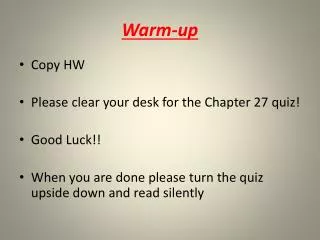
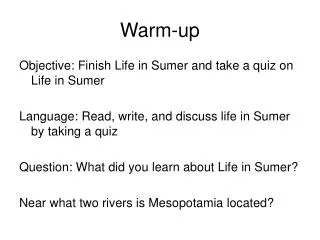
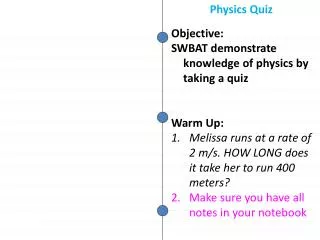
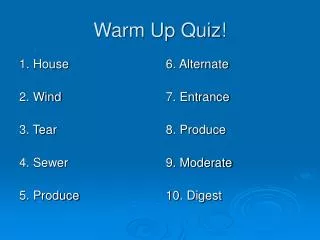
1. House 2. Wind 3. Tear 4. Sewer 5. Produce 6. Alternate 7. Entrance 8. Produce 9. Moderate 10. Digest Warm Up Quiz!
1. House – Place to live 2. Wind – Moving air 3. Tear – drop from the eye 4. Sewer – channel for waste 5. Invalid – person who is disabled 6. Alternate – switch back and forth 7. Entrance – to captivate 8. Produce – to make 9. Moderate – to preside over 10. Digest – to absorb nutrients Warm Up Answers
Heteronyms • Two words are heteronyms if they are spelled the same, but pronounced differently, and have different meanings • All heteronyms are homographs – 2 words spelled the same with different meanings
Heteronyms • May sound like easy stuff but there is a reason why English Language Learners have a problem • To make sense of it all, some have tried to categorize heteronyms: • http://jonv.flystrip.com/heteronym/heteronym.htm
Heteronyms: A Polysemus word • The other definition: One or more imaginary character(s) created by a poet, to write in different styles. • Used by well known poet Fernando Pessoa – said to have over 50 heteronyms living inside his head • Ricardo Reis, Álvaro de Campos, Alberto Caeiro (even published under these names)
Autoantonym • First remember that an antonym is an opposite therefore, • A word that can mean the opposite of itself is an autoantonym. • Sounds pretty tricky but makes more sense in a sentence: • He buckled his pants and then buckled and fell to the ground.
Antiautonyms • Antiautonyms– Try explaining this to your English Language Learners! • The strategy of applying a prefix such as in- to make an antonym backfires • Flammable/inflammable • (actually have the same/near the same meaning)
Answers to 5 B - Autoantonyms • bound (bound for Chicago, moving) (tied up, unable to move) • buckle (buckle your pants -- to hold together) (knees buckled -- to collapse, fall apart) • citation (award for good behavior) (penalty for bad behavior) • left (remaining) (having gone) • clip (attach to) (cut off from)
Antiautonyms • BONED / DEBONED • EBRIATE / INEBRIATE • I COULD CARE LESS / I COULDN'T CARE LESS:
Other Sources • http://www.absoluteastronomy.com/encyclopedia/f/fe/fernando_pessoa.htm • http://jonv.flystrip.com/heteronym/heteronym.htm