RC Circuits
80 likes | 192 Vues
This overview explores RC circuits, focusing on the role of switches and capacitors. A switch controls the open or closed state of a circuit, represented by a break in the schematic symbol. Capacitors store charge and influence voltage and current behavior, following equations such as Q = CV and V = Q/C. During discharge, voltage and current diminish over time according to an exponential curve, never fully reaching zero. The capacitor's behavior adheres to Kirchhoff’s voltage law and exhibits a time constant, which represents the rate of decay, essential for understanding electric circuits.


RC Circuits
E N D
Presentation Transcript
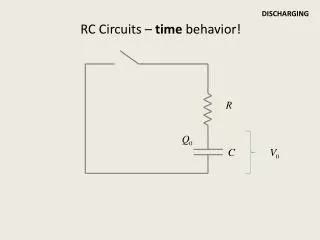
Switches • A circuit can be open or closed. • Different states at different times • A switch controls whether a circuit is open or closed. • The schematic symbol is an angled line showing a break in the circuit.
A capacitor stores charge. Related to voltage Q = CV V = Q/C A switch can be used to complete a circuit with a resistor. Current in circuit Decreases as charge is removed Capacitor Discharge I(t) C R
The voltage and current in a discharging capacitor falls with time. Fractional change is the same Never reaches zero The period of time for a decrease by a factor of e is the time constant t. Time Constant
The discharge of a capacitor can be represented by an exponential curve. Depends on initial voltage Exponential Decay
A capacitor in a circuit behaves like a voltage source. V = Q/C Depends on time A loop with a capacitor follows Kirchhoff’s voltage law. Capacitor Loop I C R
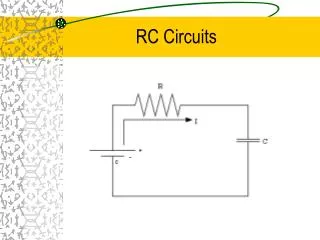
A battery can be used to charge a capacitor. Includes resistance The circuit forms one loop. The capacitor approaches a maximum voltage. V = Q/C Charging Up I(t) R V C
Charge and Discharge • The curves for charging voltage increases while the current decreases. • When potentials match there is no current.