America's Path to WWII: Key Events and Policies Unfolding from 1940 to 1941
80 likes | 246 Vues
This discussion explores the critical events leading the United States into World War II, focusing on significant policies from 1940 to 1941. Key initiatives include the Hemispheric Defense Zone, Destroyers-for-Bases Deal, Lend-Lease Act, and the Atlantic Charter. These pivotal actions demonstrate President FDR's strategic maneuvering to support allies while maintaining neutrality. Engage with the complexities of American wartime policy and the public's response, including FDR's unprecedented third term in office amid global unrest.


America's Path to WWII: Key Events and Policies Unfolding from 1940 to 1941
E N D
Presentation Transcript
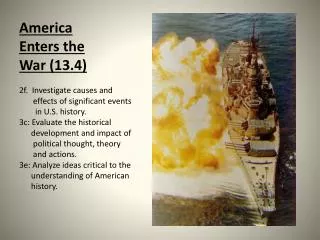
AmericaEnters the War (13.4)2f. Investigate causes and effects of significant events in U.S. history.3c: Evaluate the historical development and impact of political thought, theory and actions.3e: Analyze ideas critical to the understanding of American history.
Hemispheric Defense Zone (1940) • entire W. half of Atlantic part of W. Hemisphere &therefore neutral • FDR also ordered U.S. Navy to find U-boats and report them to British • passed b/c U-boats had sunk most of G.B. cargo ships ( + British Navy didn’t have enough ships left to protect them)
Destroyers-for-Bases Deal (1940) • G.B. wanted old WWI U.S. destroyers (U-boats sinking G.B. ships) • FDR agreed to give G.B. 50 destroyers in exchange for right to build American bases on British controlled islands (i.e. Bermuda)
Why did FDR win a 3rd term in office? • Americans wanted to stay w/ a Pres. they knew/felt comfortable w/ during period of unrest
Lend-Lease Act (1941) • allowed U.S. to lend/lease arms to any country considered “vital to the defense of the United States” (i.e. G.B, USSR, & China)
Atlantic Charter (1941) 1) A postwar world of democracy 2) Non-aggression 3) Free trade 4) Economic advance- ment 5) Freedom of the Seas
Diadem • Discussion Question #1 • In addition to agreeing to the Atlantic Charter, FDR also pledged, “to force an “incident”… which would justify the United States opening hostilities”. What did he mean by this? Do you personally find this pledge concerning? Why/why not?