Understanding Vectors: Addition, Subtraction, and Products in Physics
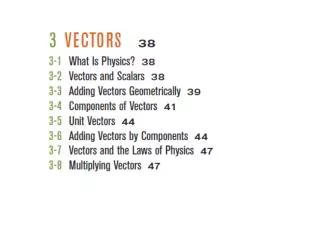
This guide explores the fundamental concepts of scalar and vector quantities, including their graphical addition and subtraction. It delves into finding vector components using trigonometry and explains how to add vectors by their components. Additionally, the guide covers the scalar (dot) product and vector (cross) product, emphasizing their significance in physics. Through various examples from PHYS 101, including work, power, torque, and angular momentum, readers will gain a comprehensive understanding of vector operations and applications.

Understanding Vectors: Addition, Subtraction, and Products in Physics
E N D
Presentation Transcript
Learning Objectives Know the difference between scalar and vector quantities Know the graphical addition (subtraction) of vectors Know how to find the components of vectors (trigonometry) Know how to add vectors by their components The scalar (dot) product of vectors in physics The vector (cross) product of vectors in physics
(3-3) Graphical Addition of Vectors A S C C S B A B B A C A A B C S = B + A + C = A + B + C = C + B + A = B + C + A S S C B
Graphical Subtraction of Vectors A S B S = A + B - C -C C S = A - B + C S -B
Unit vectors have unit magnitude and directed along one of the axes
(2) The dot (scalar) product The dot product of A and B is the length of the projection of A onto B multiplied by the length of B (or the other way around--it's commutative). Examples from PHYS 101 Work Power
(2) The cross (vector) product The magnitude of the cross product is the area of the parallelogram with two sides A and B. The resulting vector of the cross product is perpendicular to the plane containing this parallelogram. Examples from PHYS 101 Torque: Angular Momentum
How to do it Method 1 Note: Method 2