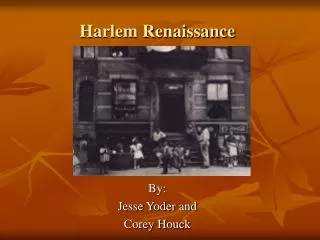
Exploring the Harlem Renaissance: Voices of Black Experience and Identity
This paper delves into the profound narratives of the Harlem Renaissance, focusing on the works of influential authors such as Langston Hughes, Zora Neale Hurston, Nella Larsen, and Claude McKay. Through poignant stories and autobiographies, these writers explore themes of racism, identity, and the collision between Black and White cultures during the 1920s and '30s. Hughes highlights the complexities of Black life, Hurston shares her rise from poverty, Larsen examines mixed-race identity, and McKay’s poetry reflects the struggles of African Americans. Together, they shed light on a pivotal era in U.S. history.

Exploring the Harlem Renaissance: Voices of Black Experience and Identity
E N D
Presentation Transcript
HARLEM RENAISSANCE English & U.S. History Paper 11th Grade 2011
LANGSTON HUGHESTHE WAYS OF WHITE FOLKS: STORIES • “In these acrid and poignant stories, Hughes depicted black people colliding--sometimes humorously, more often tragically--with whites in the 1920s and '30s.” • Historical Connections: Racism
ZORA NEALE HURSTONDUST TRACKS ON A ROAD: AN AUTOBIOGRAPHY • “Dust Tracks on a Road is Zora Neale Hurston's candid, funny, bold, and poignant autobiography, an imaginative and exuberant account of her rise from childhood poverty in the rural South to a prominent place among the leading artists and intellectuals of the Harlem Renaissance.” • Historical Connections: Racism, Identity
NELLA LARSENTHE COMPLETE FICTION • “Passing is the story of a light-skinned beauty who, after spending years passing for white, finds herself dangerously drawn to an old friend's Harlem neighborhood. In Quicksand, a restless young mulatto tries desperately to find a comfortable place in a world in which she sees herself as a perpetual outsider.” • Historical Fiction: African American female experience, Mixed-race experience
CLAUDE MCKAYSELECTED POEMS • “Jamaican-American poet Claude McKay (1889-1948) came to the U.S. in 1912 and became an important figure in the Harlem Renaissance.” • Historical Connections: Racism