Understanding the Split Brain: Insights from Roger Sperry and Michael Gazzaniga
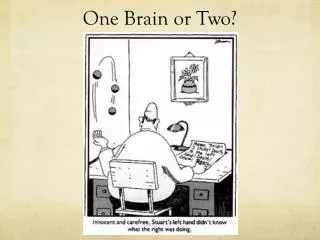
This exploration of radical treatments for epilepsy, specifically corpus callosotomy, reveals the fascinating abilities of split-brain patients. Through various tests—visual, tactile, and auditory—it becomes evident that while both hemispheres can perceive objects, only the left hemisphere can articulate what it sees. This challenges popular notions about brain lateralization, emphasizing the necessity of both hemispheres for cognitive function. Recent hypotheses suggest a unique independence in one hemisphere in certain individuals, challenging traditional understanding of consciousness and brain function.

Understanding the Split Brain: Insights from Roger Sperry and Michael Gazzaniga
E N D
Presentation Transcript
Roger Sperry & Michael Gazzaniga • Rare and extreme cases of epilepsy, radical but effective treatment – cut the corpus callosum • Of 10 operations, 4 subjects agreed to further testing
Three Types of Tests • Visual abilities test • Picture shown to one visual field • Tactile test • Feel but not see object • Auditory test • Told to reach in bag and find asked for object
Results • Visual test – • Right visual field, said object • Left visual, saw nothing • When asked to point to object in left field, did so withleft hand • Conclusion: both “brains” see the object, only left hemisphere has language skills to say what they saw • Tactile test – • Object in right hand, could say • Object in left hand, couldn’t say what it was • They could point to the same object from group in front of them • Vicki
Criticisms • Jarre Levy • Disputes pop culture ideas of being right-brained or left-brained • Two hemispheres necessary to do practically everything Recent Applications • As above, attempts to clarify the misunderstandings and misapplications • Schiffer (1996) – hypothesized that MPD person has more-than-usual level of independence in one hemisphere, takes ‘control’ of consciousness, etc.