High HIV Prevalence and Incidence among Women at Risk in Addis Ababa, Ethiopia
This study investigates HIV prevalence and incidence among women with high-risk indicators in Addis Ababa, Ethiopia. It highlights the urgent need for clinical trial sites for HIV prevention, emphasizing successful capacities in building research infrastructure and collaboration with local health authorities. The cross-sectional study included data on demographics, sexual behavior, and HIV testing, revealing an HIV prevalence of 11.3% and an incidence rate of 2.7%. The findings underscore the importance of targeted prevention trials and effective family planning programs for at-risk populations in the region.

High HIV Prevalence and Incidence among Women at Risk in Addis Ababa, Ethiopia
E N D
Presentation Transcript
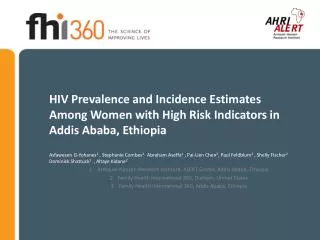
HIV Prevalence and Incidence Estimates Among Women with High Risk Indicators in Addis Ababa, Ethiopia Asfawesen G-Yohanes1 , Stephanie Combes2, Abraham Aseffa1 , Pai-Lien Chen2, Paul Feldblum2 , Shelly Fischer2 Dominick Shattuck2 , Altaye Kidane2 Armauer Hansen Research Institute, ALERT Center, Addis Ababa, Ethiopia Family Health International 360, Durham, United States Family Health International 360, Addis Ababa, Ethiopia
Overview • The need for clinical trial sites for HIV prevention research • Criteria for successful development • Collaboration in Ethiopia • Cross-sectional HIV incidence study in Addis Ababa • Parallel BED False Recent study
Introduction: Need for HIV Prevention Clinical Trial Sites • Promising results from HIV prevention trials • Male circumcision • Topical microbicide, Tenofovir gel • Oral pre-exposure prophylaxis • Continuing need for new clinical trial sites • USAID and FHI360 project to develop trial sites • Site Identification and Development Initiative (SIDI)
Dimensions of successful capacity building • Trained staff • Clinical infrastructure • Laboratory infrastructure • Data management capacity • Supportive administration • HIV prevention as part of government priorities
FHI 360 and AHRI collaboration • Armauer Hansen Research Institute (AHRI) is the research arm of ALERT Center • Has MOH support for conducting research • FHI360 & AHRI worked together to increase the clinical trial capacity at AHRI • Hired & trained staff • Increased laboratory and data management capacity • Conducted a GCP compliant HIV Incidence study
Cross-sectional HIV Incidence Study • Recruited women at higher risk of HIV infection using modified Respondent Driven sampling method • Eligibility criteria: • 18 – 35 years old • >2 heterosexual sex acts per week and/or • > 2 partners in the previous one month • Data collected: • Baseline demographics • Medical history • Sexual behaviors • HIV and pregnancy testing • Syndromic STI treatment provided, if indicated • Estimated incidence ( Recent Infection) using BED-CEIA assay
Parallel BED False Recent Study • BED-CEIA assay tends to overestimate the number of incident infections • Need to measure the local false recent rate (correction factor) • Enrolled women and men who: • Ages 18-35 • Documented as HIV-positive for at least 12 months • No history of ART (including Nevirapin) • BED testing to find proportion who falsely show as recently infected
Results - Enrollment • 1865 women enrolled in cross-sectional phase • 1855 underwent HIV testingusing parallel rapid testing • HIV positive samples tested with the BED assay • 574 enrolled in BED false recent phase • 504 women with 431 tested • 70 men with 55 tested
Cross-sectional: High Risk Behavior & FP • 94% of participants had >5 partners in the last month • 2.5% had sex with an HIV infected partner in the last month • Some form of contraception used by 90% of women • 35% used condoms only • 42% used injectables • 14% used pills
Pregnancy • Prevalence of 5.9% • Higher occurrence of pregnancies among • Condom users (9.5%) • Pill users (3.7%)
HIV Prevalence • Prevalence: 11.3% • Higher prevalence among older women (aged > 25 years) • 26.5% vs 7.9%
Predictors of HIV prevalence • In logistic regression analysis, 3 indicators were most predictive of HIV prevalence: • Being older (> 25 years old): OR = 4.4 • Presence of STI symptoms: OR = 2.4 • Having unprotected sex (no condom) in previous 7 days: OR = 1.5
HIV Incidence • Adjusted incidence: 2.7% [1.7% - 3.6%] • Incidence by age group is similar • 18-24 Yrs: 2.5% • 25-35 Yrs: 3.0%
Conclusions • One of first studies in Ethiopia to specifically measure HIV incidence • Incidence is high enough to justify HIV prevention trials • Age, STI symptoms, & recent unprotected sex are greatest risk factors for prevalent infections • Family planning is another reproductive health need • Large sub-group of women at higher risk of HIV in this section of Addis • AHRI well placed for future prevention research & programming
Acknowledgements • SIDI Team at AHRI • Addis Ababa City Admin Health Bureau • KolfeKeranyoSubcity Administration, Wereda and Kebele Offices • ALERT, Zwditu M, St Paul and Yekatit 12 Hospitals • Wereda 23, 24, 25 Health Centers • HAPCSO • FHI360-NC: Connie Sexton** • FHI 360-Ethiopia: Francesca Stuer