SlideServe
Menu
Préférences
© SlideServe · v2026

Future Directions Conference: Fostering Graduate Success

tolinka-gomez avatar
11 diapositives · 212 Views · Nov 06, 2014

Join the Inaugural Future Directions Conference by Glyndŵr University to explore themes such as authentic learning, developing graduate attributes, and expanding professional networks. Learn how to measure the impact of initiatives in improving graduate employability.
Future Directions Conference: Fostering Graduate Success - slide 1
01 / 11Future Directions Conference: Fostering Graduate Success
1 / 17

Télécharger la présentation

Future Directions Conference: Fostering Graduate Success
Une image / un lien ci-dessous est fourni (tel quel) pour télécharger la présentation

Politique de téléchargement : le contenu du site vous est fourni TEL QUEL pour votre information et votre usage personnel ; il ne peut être vendu, concédé sous licence ni partagé sur d’autres sites sans l’accord de son auteur.Le contenu vous est fourni TEL QUEL, pour votre information et votre usage personnel uniquement. Téléchargez la présentation en cliquant sur ce lien. Lors du téléchargement, si vous ne parvenez pas à télécharger une présentation, l’éditeur a peut-être supprimé le fichier de son serveur.Pendant le téléchargement, si vous ne parvenez pas à obtenir une présentation, le fichier a peut-être été supprimé par l’éditeur.

F I N

Plus de contenu associé

Transcription de la présentation
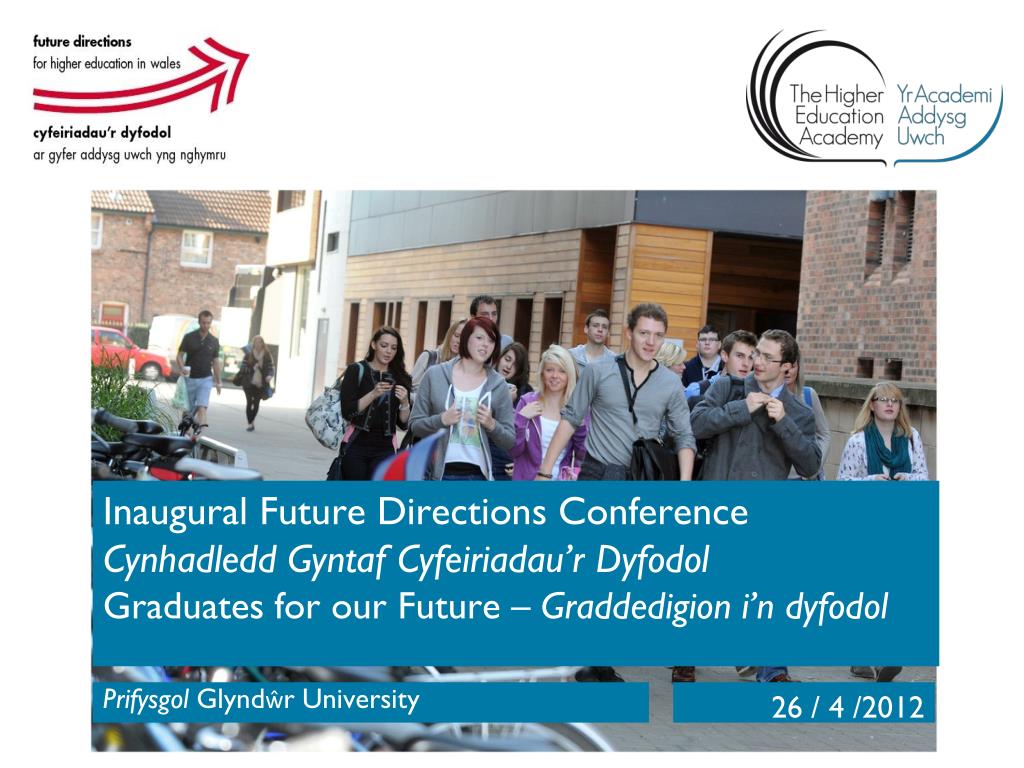
  1. Inaugural Future Directions ConferenceCynhadledd Gyntaf Cyfeiriadau’r Dyfodol Graduates for our Future – Graddedigion i’n dyfodol • Prifysgol Glyndŵr University • 26 / 4 /2012

  2. Themes from Case Studies Authentic Learning Careers Awareness & Application Skills Developing Graduate Attributes Developing Leadership & Enterprise Expanding Professional Networks Creating Resources to help Employability

  3. How can we measure the IMPACT of initiatives?

  4. Clarity of Purpose(adapted from Baume, 2003) Evaluation & monitoring (Why) Defining parameters (What) • To account; for resources expended and goals (in whatever terms these goals are expressed) achieved. • To improve; the venture being evaluated and future such ventures. • And to understand; why the venture is having the effects that it is having (in order to inform improvement). What do you mean by employability? What is the intended difference that you want to make? What will show you that you have succeeded in making that difference?

  5. OUTCOMES AND INDICATORS (examples) Hard Outcomes Soft Outcomes Not everything that counts can be counted, and not everything that can be counted counts’ Increased % of students in graduate jobs Number of students achieving additional, work related, awards Increased profile of graduate employability attributes in programmes Greater satisfaction with preparation for work

  6. But many possible approaches can be identified… • Pre- and post-activity questionnaires to track changes • Setting benchmarks • Number of placements and jobs secured • Increase in numbers of staff engaging in employability agenda • Employer evaluation of placements • KPIs within review of strategic plan • Developing enabling, process and outcome indicators • Range of short-, medium- and longer-term Pis • Active involvement of students in planning and development • Feedback from champions • Quality of graduates and applicants (in the longer-term) • Case studies • Internal team established to review activities • Longitudinal study of student motivations • Linking to wider longitudinal survey • Graduate employment rates • Feedback from employer liaison groups • Levels of attendance at events/usage of materials/subsequent follow-up contacts • Explicit statements on employability in all course handbooks

  7. Empirical Investigations Mason et al (2006) Employability Skills Initiatives in Higher Education: What Effects Do They Have On Graduate Labour Market Outcomes? SQW Consulting (September 2011) Strategic Funding to Develop Graduate Employability Final report to the Scottish Funding Council Recent study on measuring the impact of HE careers services (AGCAS, 2011) – survey

  8. Consider other Evaluations of Impact For Example ‘The Rugby Team Impact Framework’ (RTIF) an evaluation model developed for assessing the training of researchers in higher education

  9. Some considerations regarding employment Employability skills are not only relevant to the first job students may gain but also for graduate prospects at future points of career development. There are many influences on employment and the ‘graduate premium’, e.g. the subject(s) studied and labour market factors

  10. Some considerations regarding evaluation • We need clear definitions • “Outcomes-based funding for training is only as good as the definition of the outcomes.”(UKCES 2009) • Issues are often complex & attributing causality is always a problem • There are always multiple interested parties & they may have different issues

  11. Basic Questions