Master Self-Questioning Strategies for Enhanced Learning and Comprehension
Discover effective self-questioning strategies to improve your learning with the QAR (Question-Answer-Relationship) framework. This guide outlines four types of questions: Right There, Think and Search, Author and Me, and On My Own. Learn how to identify where to find your answers in texts, combine information, and connect it with your prior knowledge. With practical tips, such as restating questions and using complete sentences, you will master the art of questioning to enhance comprehension skills and promote deeper understanding in reading.

Master Self-Questioning Strategies for Enhanced Learning and Comprehension
E N D
Presentation Transcript
Question-Answer-Relationship Purpose: To learn better self questioning strategies
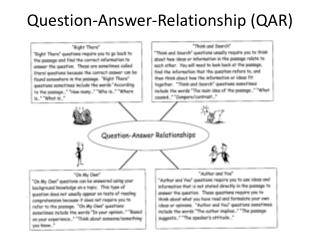
2 Sources of Information IN THE BOOK IN MY HEAD Author and Me On My Own • Right There • Think and Search
RIGHT THERE • The words used to make up the question and words used to answer the question are RIGHT THERE in the same sentence • Ask yourself- • “Can I find the answer in one sentence?”
THINK AND SEARCH • The answer is in the text, BUT you must put together different pieces of information to find it. • Words for the question and words for the answer are not found in the same sentence, they come from different places in the text.
AUTHOR AND ME • The answer is NOT in the text. • Think about what you already know • What the author tells you in the text • How the 2 fit together
ON MY OWN • Can answer the question without reading the text • Will need to use your own experience to answer the questions • NOT on Reading FCAT
Question – Answer - Reading Reminders • QAR Abbreviations • RT- Right There • TS- Think and Search • AM- Author and ME • OMO- On My Own • GO- Graphic Organizer • Check list for EVERY question: • Question type and paragraph number • Restate question in your answer • Use CORRECT capital letters and punctuation • Write in complete sentences • Have correct answer